I have recently been reading Connor Cruise O'Brien's book on Burke, The Great Melody, which I highly recommend, especially as an antidote to the highly selective uses of Burke by pop conservatives like Brooks and Will. So anyway, I also picked up another book by O'Brien, The Long Affair, which is, in the first place, about Jefferson's fascination with the French Revolution - what O'Brien calls his cult of the French Revolution, and his full-throated defense of Terror in the name of "Liberty." But the thesis is much bigger than that. O'Brien wants to undermine the liberal white-washing of Jefferson, especially when it comes to race. He points out that Jefferson was bitterly opposed to the very idea of a multi-racial society and that the only way he could contemplate slavery ending would be with the freed slaves immediately shipped back to Africa.
The final chapter finds O'Brien worrying, circa 1996, about the prospects of American democracy. He says that American civic religion cannot be adapted to a genuinely multi-racial democracy without jettisoning Jefferson from the pantheon. And he worries that this in turn may produce a schism, with the return of what has been repressed in the liberal portrait of Jefferson ( the release of "the spell-binding and anarchic racist prophet within Jefferson") in which Jefferson would become "the prophet and patriot of the fanatical racist far right in America."
Needless to say, reading this in the wake of the news story from this past summer about the guy who showed up at one of Obama's town-halls with a loaded gun, wearing a shirt inscribed with the "watering the tree of liberty with the blood of tyrants" quote from Jefferson - well, it was beyond chilling.

Wednesday, September 30, 2009


Will The Fed Unwind Its Enormous Balance Sheet Via Reverse Repos?
A few days ago at Econbrowser, Jim Hamilton showed the latest Fed balance sheet and quoted scattered reports that Bernanke and the Fed are contemplating the use of "reverse repos" to unwind the Fed's balance sheet, which has been about three times its normal size since last September, "Federal Reserve reverse repurchases". The balance sheet was initially ballooned by such entities as the TAF and the CPLF, which picked up all kinds of things, from banks and whatnot in the US economy to something like $600 billion in euro-junk. However, there has been a noticeable shift since January, with that stuff getting unwound, and the main item keeping the balance sheet thick with liabilities being a massive increase in repurchase (repo) agreements. Indeed, this has long been the main tool by which the Fed has engaged in open market expansion operations. The new report is that they are hoping to drain these through reverse repos, but are hoping to do so without "tightening." Hmm, we shall see...
Tuesday, September 29, 2009
The Blowing Winds Of Climate Change in Australia
Last Sunday, 27th September, the Australian state of Tasmania was battered by exceptionally strong winds that brought down thousands of trees, ripped off roofs and guttering from houses, tore power lines and blocked many rural roads with large piles of debris from fallen limbs and trunks of trees from adjacent forests and plantations.
Today, two and a half days after the event, our house is one of the 2,700 still without power.[1] There are at least a dozen large trees on our bush block that lie with their roots protruding out of the ground. Fortunately the local road is now just cleared enough to allow access to vehicles but powerlines are down; they lie in a neighbour's paddock. A tree still leans precariously onto electricity wires only half a kilometre away.[2]
The sheer force of the winds were beyond the experience of local people. Farmer Hayes approached on his tractor this morning. He simply nodded his head in his usual mode of gleeful resignation and declared that we can now expect this sort of thing from now on. "We may as well get used to it."
Only four days earlier a red dust cloud "70 times the level rated hazardous" to health [3] enveloped large parts of New South Wales and southern Queensland; an area approximately 1,500 kilometres long by 400 kilometres wide [4].... to be more precise. This was yet another unprecedented event. No other single dust storm of such magnitude has occurred before, although the last one in October 2002 came close.
Paramedics attended hundreds of calls to distressed, choking individuals. Airline flights were cancelled or redirected to other cities. Traffic was held up for hours due to low visibility. However, the repercussions for Australian farmers after the loss of roughly four million tonnes of soil is yet to be felt.
It is hard to avoid the conclusion that this month heralds the new winds of climate change in Australia. The portents are so many that most people in this hotter and dryer island continent are pretty well convinced that the weather we have now is entirely new and ominous.
Abrupt and stark changes are happening in Australia's climate[5] and landscape so frequently they're becoming a type of online diary entry for me. This winter just ended was Australia's hottest on record.[6] It followed only a few month's after Australia's most catastrophic summer [7] which, in turn, was followed by massive fire outbreaks in Southern Australia.[8] These six hundred odd fires in one state alone were yet another example of a tragedy whose enormity (like the vast majority of other recent changes) is unprecedented in its scale and effect.
The blunt truth is that the changes in our climate give Australia its new reality. It gives it now; it gives it with or without our acceptance. Things have already become very complicated.
Unfortunately, the climate didn't wait for us.
[1] http://www.examiner.com.au/news/local/news/disasters-accidents/2700-still-without-power-and-it-could-be-days-for-some/1634901.aspx
[2] I write from the house of a family member.
[3] 'Air-quality readings off the chart' Aden Creswell and Angus Hohenboken. The Australian, page 6. 24th September 2009.
[4] 'Red Centre causes havoc in big city' The Australian. Page 1. 24th September 2009.
[5] Outside of the Vortex. Brenda Rosser
http://econospeak.blogspot.com/2009/03/outside-of-vortex.html
[6] Only a Decade. Brenda Rosser
http://econospeak.blogspot.com/2009/09/only-one-decade.html
[7] Australia's Catastrophic Summer of 2009. Brenda Rosser. Jan/Feb 2009
http://econospeak.blogspot.com/.../australias-catastrophic-summer-of-2009.html
[8] Australia's Catastrophic Summer - Update. Brenda Rosser. February 2009
http://econospeak.blogspot.com/2009/02/australias-catastrophic-summer-update.html
Today, two and a half days after the event, our house is one of the 2,700 still without power.[1] There are at least a dozen large trees on our bush block that lie with their roots protruding out of the ground. Fortunately the local road is now just cleared enough to allow access to vehicles but powerlines are down; they lie in a neighbour's paddock. A tree still leans precariously onto electricity wires only half a kilometre away.[2]
The sheer force of the winds were beyond the experience of local people. Farmer Hayes approached on his tractor this morning. He simply nodded his head in his usual mode of gleeful resignation and declared that we can now expect this sort of thing from now on. "We may as well get used to it."
Only four days earlier a red dust cloud "70 times the level rated hazardous" to health [3] enveloped large parts of New South Wales and southern Queensland; an area approximately 1,500 kilometres long by 400 kilometres wide [4].... to be more precise. This was yet another unprecedented event. No other single dust storm of such magnitude has occurred before, although the last one in October 2002 came close.
Paramedics attended hundreds of calls to distressed, choking individuals. Airline flights were cancelled or redirected to other cities. Traffic was held up for hours due to low visibility. However, the repercussions for Australian farmers after the loss of roughly four million tonnes of soil is yet to be felt.
It is hard to avoid the conclusion that this month heralds the new winds of climate change in Australia. The portents are so many that most people in this hotter and dryer island continent are pretty well convinced that the weather we have now is entirely new and ominous.
Abrupt and stark changes are happening in Australia's climate[5] and landscape so frequently they're becoming a type of online diary entry for me. This winter just ended was Australia's hottest on record.[6] It followed only a few month's after Australia's most catastrophic summer [7] which, in turn, was followed by massive fire outbreaks in Southern Australia.[8] These six hundred odd fires in one state alone were yet another example of a tragedy whose enormity (like the vast majority of other recent changes) is unprecedented in its scale and effect.
The blunt truth is that the changes in our climate give Australia its new reality. It gives it now; it gives it with or without our acceptance. Things have already become very complicated.
Unfortunately, the climate didn't wait for us.
[1] http://www.examiner.com.au/news/local/news/disasters-accidents/2700-still-without-power-and-it-could-be-days-for-some/1634901.aspx
[2] I write from the house of a family member.
[3] 'Air-quality readings off the chart' Aden Creswell and Angus Hohenboken. The Australian, page 6. 24th September 2009.
[4] 'Red Centre causes havoc in big city' The Australian. Page 1. 24th September 2009.
[5] Outside of the Vortex. Brenda Rosser
http://econospeak.blogspot.com/2009/03/outside-of-vortex.html
[6] Only a Decade. Brenda Rosser
http://econospeak.blogspot.com/2009/09/only-one-decade.html
[7] Australia's Catastrophic Summer of 2009. Brenda Rosser. Jan/Feb 2009
http://econospeak.blogspot.com/.../australias-catastrophic-summer-of-2009.html
[8] Australia's Catastrophic Summer - Update. Brenda Rosser. February 2009
http://econospeak.blogspot.com/2009/02/australias-catastrophic-summer-update.html
Monday, September 28, 2009
Worth Quoting
"The 'flexibility' explanation of unemployment is wrong." -- Bell and Blanchflower, "What Should Be Done about Rising Unemployment in the UK?" February 2009, page 15. To elaborate on that point:
In a recent article, Howell et al (2007) econometrically examined the impact of these rigidity variables, or what they call Protective Labor Market Institutions (PLMIs), and concluded that: "while significant impacts for employment protection, benefit generosity, and union strength have been reported, the clear conclusion from our review of these studies is that the effects for the PLMIs is distinctly unrobust, with widely divergent coefficients and levels of significance." Indeed, in his published comments on the Howell et al. article, Jim Heckman (2007) argues that the authors "…are convincing in showing the fragility of the evidence on the role of labour market institutions in explaining the pattern of European unemployment, using standard econometric methodology." Freeman (2007) also finds the evidence for the impact of these institutional variables less than convincing "despite considerable effort, researchers have not pinned down the effects, if any, of institutions on other aggregate economic outcomes, such as unemployment and employment."
Fooled by Randomness
"Hysteria seems especially out of place when people proclaim that the large losses triggered by derivatives could threaten the stability of the world financial system. While enormous leverage and extraordinary potential losses from derivatives will continue to receive banner headlines, a number of international study groups have concluded that a spreading worldwide financial crisis caused by derivatives is highly unlikely. Speculators who take large risks will continue to risk ruin, and some financial institutions -- even large ones -- will continue to fail. But a systematic undermining of world financial stability caused by derivatives trading does not deserve to be on the top of anyone's worry list." -- Burton G. Malkiel, A Random Walk Down Wall Street: The Time-Tested Strategy for Successful Investing, p. 415, 2007 (revised and updated, but not updated quite enough)
It's On!
by the Sandwichman
David Blanchflower's keynote address to the OECD Policy Forum: "How can Labour Market and Social Policies best help workers weather the storm of the crisis?." Page 19 (the punchline):
Keynes’ Biographer Lord Robert Skidelsky
"Keynes’s big idea was to use macroeconomic policy to maintain full employment. His specific suggestion was to use monetary policy to secure a permanently low interest rate and fiscal policy to achieve a continuously high level of public or semi-public investment.
"Over time, as the returns on further additions to capital fell, the high-investment policy should yield to the encouragement of consumption through redistributing income from the higher to the lower-saving section of the population. This should be coupled with a reduction in the hours of work. In short, the object of macro-policy should be to keep the economy in 'quasi-boom' till the economic problem was solved and people could live 'wisely, and agreeably, and well.'"
David Blanchflower's keynote address to the OECD Policy Forum: "How can Labour Market and Social Policies best help workers weather the storm of the crisis?." Page 19 (the punchline):
Keynes’ Biographer Lord Robert Skidelsky
"Keynes’s big idea was to use macroeconomic policy to maintain full employment. His specific suggestion was to use monetary policy to secure a permanently low interest rate and fiscal policy to achieve a continuously high level of public or semi-public investment.
"Over time, as the returns on further additions to capital fell, the high-investment policy should yield to the encouragement of consumption through redistributing income from the higher to the lower-saving section of the population. This should be coupled with a reduction in the hours of work. In short, the object of macro-policy should be to keep the economy in 'quasi-boom' till the economic problem was solved and people could live 'wisely, and agreeably, and well.'"
Sunday, September 27, 2009
Washington Post Puffs Gold Buggery
The business section of today's Washington Post contains one of the most ridiculous news stories I have seen yet. I would not mind if this were a column, but "What's Making Gold a Hot Commodity" by Frank Ahrens is supposedly a news story, and as such it should not contain whoppingly erroneous statements without some correction. So, Ahrens himself says the following: "In the long term, with each new dollar introduced into the system, each dollar you hold becomes worth less. That's more than just inflation, which we think of as simply rising prices. That's debasement of not only our currency, but the globe's reserve currency." It may well be that nonsensical thinking such as this has pushed the price of gold back over $1,000 per ounce again, but why should a business section reporter repeat it without the slightest doubt. It is not even good monetarism, as monetarists only view money supply expansions beyond growth of real output and not offset by velocity changes as inflationary.
A bit later, Ahrens uncritically quotes Peter Boockvar, an equities trader at Miller Tabak: "It amazes me that any self-respecting central banker is not alarmed that gold is over $1,000 an ounce and the dollar is trading at all-time record lows." All-time record lows? Only against gold. Currently the dollar is about 1.46 against the euro, while it hit 1.5990 in July 2008. It is around 92 against the yen, but in 1995 got as low as 79.95. It is a bit over 1.5 against the pound, but was at 1.98 last year (and further back in history was over 4.0). Utter drivel.
I do recognize that later in the article Ahrens brings up some factors that might caution people a bit against buying gold too frenziedly, such as how much of it is held by central banks, and how little demand for it is due to industrial use (only about 10%). But he never mentions that it has already been above $1,000 twice before, only to fall back, and in the late 1970s was much higher in real terms, at well over $800, only to fall very far below that and stay well below that for decades. The warnings could have been a bit clearer, along with avoiding mindlessly repeating totally ridiculous non-facts spouted by wacko gold bugs.
A bit later, Ahrens uncritically quotes Peter Boockvar, an equities trader at Miller Tabak: "It amazes me that any self-respecting central banker is not alarmed that gold is over $1,000 an ounce and the dollar is trading at all-time record lows." All-time record lows? Only against gold. Currently the dollar is about 1.46 against the euro, while it hit 1.5990 in July 2008. It is around 92 against the yen, but in 1995 got as low as 79.95. It is a bit over 1.5 against the pound, but was at 1.98 last year (and further back in history was over 4.0). Utter drivel.
I do recognize that later in the article Ahrens brings up some factors that might caution people a bit against buying gold too frenziedly, such as how much of it is held by central banks, and how little demand for it is due to industrial use (only about 10%). But he never mentions that it has already been above $1,000 twice before, only to fall back, and in the late 1970s was much higher in real terms, at well over $800, only to fall very far below that and stay well below that for decades. The warnings could have been a bit clearer, along with avoiding mindlessly repeating totally ridiculous non-facts spouted by wacko gold bugs.
OECD Jobs Crisis Policy Forum
As part of the OECD Labour and Employment Ministerial meeting on the Jobs Crisis, taking place in Paris on Monday and Tuesday, there will be a policy forum engaging "the social partners, researchers, Ministers and representatives of the civil society." (One wonders what the difference is between "social partners" and "representatives of the civil society". Are the partners not civil?). Professor David Blanchflower will be the keynote speaker at the Policy Forum.
Blanchflower is a "happiness" economist and, as a member of the Bank of England's Monetary Policy Committee, was early in warning of the impending credit crisis. He has also been in the front lines warning of the jobs crisis and now writes a weekly column for the New Statesman.
The Policy Forum's website presents four questions for discussion at the forum:
1. "Are standard employment policies adequate to respond to the crisis?"
Certainly not.
2. "Do these measures need to be reinforced or complemented by other less conventional measures?"
Yes, see below.
3. "What should be done to minimize the risk that the current steep rise in unemployment will become persistent into the recovery and beyond?"
The traditional trade union prescription for high unemployment put forward in the 19th century, in the 1930s and even as late as the 1950s and 1960s was to reduce the hours of work. Samuel Gompers said, "So long as there is one man who seeks employment and cannot find it, the hours of work are too long." John Maynard Keynes agreed. In a 1945 letter to T.S. Eliot, Keynes explained, "The full employment policy by means of investment is only one particular application of an intellectual theorem. You can produce the result just as well by consuming more or working less. Personally I regard the investment policy as first aid. In U.S. it almost certainly will not do the trick. Less work is the ultimate solution." Keynes expressed the same opinion more formally in a 1943 Treasury Department memorandum on "The Long Term Problem of Full Employment".
A fuller explanation of the theory underlying the trade union position can be found in Dorothy Wolff Douglas's 1932 Journal of Political Economy article on "Ira Steward on Consumption and Unemployment". For the context of Keynes's views on working less and their centrality to Keynes's thought, see the conclusion to Robert Skidelsky's 1998 paper, "Keynes and Employment Policy in the Second World War." In light of the uncanny convergence between Steward's ideas on unemployment and Keynes's, it would be a serious mistake to overlook them.
4. "How can dialogue with social partners and other stakeholders facilitate the design and implementation of the most suitable labour market and social policy package to help workers weather the storm of the crisis?"
Dialogue on the relationship between unemployment, wages and reduction of the hours of work has been effectively banished from mainstream economics by the bogus accusation that proponents of shorter working time commit a "lump of labor fallacy". Even the unions in the US have finally acceded to the shibboleth. Below is the abstract to my 2007 Review of Social Economy article, "Why Economists Dislike a Lump of Labor":
"The lump-of-labor fallacy has been called one of the “best known fallacies in economics.” It is widely cited in disparagement of policies for reducing the standard hours of work, yet the authenticity of the fallacy claim is questionable, and explanations of it are inconsistent and contradictory. This article discusses recent occurrences of the fallacy claim and investigates anomalies in the claim and its history. S.J. Chapman's coherent and formerly highly regarded theory of the hours of labor is reviewed, and it is shown how that theory could lend credence to the job-creating potentiality of shorter working time policies. It concludes that substituting a dubious fallacy claim for an authentic economic theory may have obstructed fruitful dialogue about working time and the appropriate policies for regulating it."
The unreasoning antagonism of contemporary economists to shorter hours of work is not unprecedented. Mark Blaug's 1958 article, "The Classical Economists and the Factory Acts," revealed how most of the 19th century political economists opposed the reduction of hours on the basis of "principles" that owed nothing to any actual economic analysis. Fortunately, that earlier opposition was overcome by persistent agitation. The current impasse, though, has been hard-wired into theoretical models that owe more to their fanciful premises than to their mathematical rigor.
Blanchflower is a "happiness" economist and, as a member of the Bank of England's Monetary Policy Committee, was early in warning of the impending credit crisis. He has also been in the front lines warning of the jobs crisis and now writes a weekly column for the New Statesman.
The Policy Forum's website presents four questions for discussion at the forum:
- Are standard employment policies adequate to respond to the crisis?The Sandwichman sent Professor Blanchflower his response to these four questions and is pleased that he has acknowledged the email. Below are the responses.
- Do these measures need to be reinforced or complemented by other less conventional measures?
- What should be done to minimize the risk that the current steep rise in unemployment will become persistent into the recovery and beyond?
- How can dialogue with social partners and other stakeholders facilitate the design and implementation of the most suitable labour market and social policy package to help workers weather the storm of the crisis?
1. "Are standard employment policies adequate to respond to the crisis?"
Certainly not.
2. "Do these measures need to be reinforced or complemented by other less conventional measures?"
Yes, see below.
3. "What should be done to minimize the risk that the current steep rise in unemployment will become persistent into the recovery and beyond?"
The traditional trade union prescription for high unemployment put forward in the 19th century, in the 1930s and even as late as the 1950s and 1960s was to reduce the hours of work. Samuel Gompers said, "So long as there is one man who seeks employment and cannot find it, the hours of work are too long." John Maynard Keynes agreed. In a 1945 letter to T.S. Eliot, Keynes explained, "The full employment policy by means of investment is only one particular application of an intellectual theorem. You can produce the result just as well by consuming more or working less. Personally I regard the investment policy as first aid. In U.S. it almost certainly will not do the trick. Less work is the ultimate solution." Keynes expressed the same opinion more formally in a 1943 Treasury Department memorandum on "The Long Term Problem of Full Employment".
A fuller explanation of the theory underlying the trade union position can be found in Dorothy Wolff Douglas's 1932 Journal of Political Economy article on "Ira Steward on Consumption and Unemployment". For the context of Keynes's views on working less and their centrality to Keynes's thought, see the conclusion to Robert Skidelsky's 1998 paper, "Keynes and Employment Policy in the Second World War." In light of the uncanny convergence between Steward's ideas on unemployment and Keynes's, it would be a serious mistake to overlook them.
4. "How can dialogue with social partners and other stakeholders facilitate the design and implementation of the most suitable labour market and social policy package to help workers weather the storm of the crisis?"
Dialogue on the relationship between unemployment, wages and reduction of the hours of work has been effectively banished from mainstream economics by the bogus accusation that proponents of shorter working time commit a "lump of labor fallacy". Even the unions in the US have finally acceded to the shibboleth. Below is the abstract to my 2007 Review of Social Economy article, "Why Economists Dislike a Lump of Labor":
"The lump-of-labor fallacy has been called one of the “best known fallacies in economics.” It is widely cited in disparagement of policies for reducing the standard hours of work, yet the authenticity of the fallacy claim is questionable, and explanations of it are inconsistent and contradictory. This article discusses recent occurrences of the fallacy claim and investigates anomalies in the claim and its history. S.J. Chapman's coherent and formerly highly regarded theory of the hours of labor is reviewed, and it is shown how that theory could lend credence to the job-creating potentiality of shorter working time policies. It concludes that substituting a dubious fallacy claim for an authentic economic theory may have obstructed fruitful dialogue about working time and the appropriate policies for regulating it."
The unreasoning antagonism of contemporary economists to shorter hours of work is not unprecedented. Mark Blaug's 1958 article, "The Classical Economists and the Factory Acts," revealed how most of the 19th century political economists opposed the reduction of hours on the basis of "principles" that owed nothing to any actual economic analysis. Fortunately, that earlier opposition was overcome by persistent agitation. The current impasse, though, has been hard-wired into theoretical models that owe more to their fanciful premises than to their mathematical rigor.
Friday, September 25, 2009
Occupation at UC Santa Cruz
Occupation Statement
"Let’s be frank: the promise of a financially secure life at the end of a university education is fast becoming an illusion. The jobs we are working toward will be no better than the jobs we already have to pay our way through school. Close to three-quarters of students work, many full-time. Even with these jobs, student loan volume rose 800 percent from 1977 to 2003. There is a direct connection between these deteriorating conditions and those impacting workers and families throughout California. Two million people are now unemployed across the state. 1.5 million more are underemployed out of a workforce of twenty million. As formerly secure, middle-class workers lose their homes to foreclosure, Depression-era shantytowns are cropping up across the state. The crisis is severe and widespread, yet the proposed solutions – the governor and state assembly organizing a bake sale to close the budget gap – are completely absurd.
"We must face the fact that the time for pointless negotiations is over. Appeals to the UC administration and Sacramento are futile; instead, we appeal to each other, to the people with whom we are struggling, and not to those whom we struggle against. A single day of action at the university is not enough because we cannot afford to return to business as usual. We seek to form a unified movement with the people of California. Time and again, factional demands are turned against us by our leaders and used to divide social workers against teachers, nurses against students, librarians against park rangers, in a competition for resources they tell us are increasingly scarce. This crisis is general, and the revolt must be generalized. Escalation is absolutely necessary. We have no other option.
"Occupation is a tactic for escalating struggles, a tactic recently used at the Chicago Windows and Doors factory and at the New School in New York City. It can happen throughout California too. As undergraduates, graduate students, faculty, and staff, we call on everyone at the UC to support this occupation by continuing the walkouts and strikes into tomorrow, the next day, and for the indefinite future. We call on the people of California to occupy and escalate."
Mankiw, Posner, Krugman (and Leonard) on Skidelsky on Keynes
by the Sandwichman
Paul Krugman in the Guardian and N. Gregory Mankiw in the Wall Street Journal have written reviews of Robert Skidelsky's Keynes, The Return of the Master. Now Richard Posner in the New Republic gives the book prominent mention in his essay on "How I Became a Keynesian." That's pretty respectable buzz.
But only Andrew Leonard on Salon.com really gets it:
Paul Krugman in the Guardian and N. Gregory Mankiw in the Wall Street Journal have written reviews of Robert Skidelsky's Keynes, The Return of the Master. Now Richard Posner in the New Republic gives the book prominent mention in his essay on "How I Became a Keynesian." That's pretty respectable buzz.
But only Andrew Leonard on Salon.com really gets it:
To your run-of-the-mill market fundamentalist, questions of ethics are irrelevant. Capitalism works by satisfying consumer needs and wants. Government should stay out of the way. But Keynes is on the comeback trail because our present-day predicament shows this to be manifestly untrue.Posner bites but can't quite swallow:
Let me give the microphone to Skidelsky. In a paragraph and a half, he asks a set of questions that are at the heart not just of his book, but of our existence on this planet.Keynes looked forward to a saturation of wants. But he did not see this as a natural, but an ethical terminus. Wants were to be controlled not by the size of the stomach, but by a generally accepted conception of "sufficiency" for the good life.If Keynes were alive today, these would be questions he would be asking. And after reading "Keynes: The Return of the Master," one can only conclude that we would be well-served to have him out and about, confounding the status quo with his impertinence.
In terms of arithmetic, he was almost spot on in his predictions of growing wealth, but attitudes have changed less than he expected. Although real incomes in rich countries have doubled in the last thirty years, the populations of these countries work harder than ever and are no happier. This raises the question of why they are still on the growth treadmill. Is it because capitalism needs constantly to expand markets, and ensnare by advertising more and more people into useless consumption? Is it because economists have ignored the fact that, as societies become wealthier, positional goods -- goods which satisfy not our needs, but our longing for status -- become more and more desirable? Is it because globalization has made affluence too insecure and too uneven in its spread for most people in wealthy societies to ease off work? Or is it because we lack any agreed idea of the good life in the name of which we can say "enough is enough"?
And then the challenge to society would be the management of unprecedented voluntary leisure. This was a popular 1930s theme--think of Huxley's Brave New World--but it underestimated the ability of business to create new wants, and new goods and services to fulfill them.Mankiw is unable to find it with a flashlight:
That was merely a mistake, an oddity in Keynes's belief in the possibility of perpetual boom.
According to Keynes, economic downturns are not a fundamental indictment of the market economy. Rather, recessions and depressions arise from insufficient aggregate demand. A smart government can remedy the problem with its monetary and fiscal policy—say, by printing up some money and spending it. Once the right policies are put in place, the thinking goes, the world is safe again for free markets.Krugman is enthusiastic about the book but reserved about the prescription:
Surely it's possible to make the case for a less profound reconstruction of economics than Skidelsky advocates...To again give the microphone to Skidelsky: "Down with Keynsianism, and up with Keynes!"
Thursday, September 24, 2009
Econospeak #19 blog for Econ students?
Yesterday an outfit called Online Universities Weblog posted a list of "100 Best Blogs for Econ Students." http://www.onlineuniversities-weblog.com/50226711/100-best-blogs-for-econ-students.php Blogs were listed in order with numbers in categories, with Econospeak at #19 and in the first category of "General." This was posted on Marginal Revolution with little comment, although some of the commenters there made negative remarks about the list (perhaps because Marginal Revolution came in at #86 under the "Hard Times" category, even though some its allied libertarian blogs were very near the top, Econlog at #2 and Cafe Hayek at #3.
In any case, I do not think I want to make too much about the numerical ranking, but I do think it is interesting to get the recognition, and pretty early on in the list, whoever these folks are. Most recently Econospeak is 57th in the Gongol.EconDirectoy ranking based on views per page among economics blogs. Just before Max stepped aside, Maxspeak was at 12th. This blog has been as high as in the low 40s, but more recently has been floating around in the 50s and 60s. I further note that the Online Universities Weblog people gave no criteria or reasons for their selection or rankings, if they even are rankings at all, which is unclear.
In any case, I do not think I want to make too much about the numerical ranking, but I do think it is interesting to get the recognition, and pretty early on in the list, whoever these folks are. Most recently Econospeak is 57th in the Gongol.EconDirectoy ranking based on views per page among economics blogs. Just before Max stepped aside, Maxspeak was at 12th. This blog has been as high as in the low 40s, but more recently has been floating around in the 50s and 60s. I further note that the Online Universities Weblog people gave no criteria or reasons for their selection or rankings, if they even are rankings at all, which is unclear.
Wednesday, September 23, 2009
Did the Green Revolution Succeed in India?
Saby Ganguly (an Indian business writer who was a former editorial consultant to the World Organization of Building Officials (WOBO), an affiliate of the United Nations) wrote a report on the success of the green revolution in India entitled: “From the Bengal Famine to the Green Revolution”
Yield per unit of farmland, Ganguly wrote, “improved by more than 30 per cent between 1947 [when India gained political independence from the British] and 1979 when the Green Revolution was considered to have delivered its goods."
HOWEVER
The ‘green revolution’ didn’t begin until 1967 so the writer is counting 20 years of increasing agricultural yield from India’s ‘Land Transformation Program’ and only 12 years of increasing yield from the Green Revolution. The tick for success in this period, however, is given by Ganguly to the GR. This is also irrespective of the fact that the variety of crops used in the GR needed more water, more fertilizer, more fungicides and other chemicals.
Then, later in the article, Saby Ganguly switches tack altogether and refers to the green revolution as being a success in terms of the extra gross domestic product (GDP) generated. That is, the author changes the evaluation methodology for the GR. Extra food yield per unit of land is discarded as a measurement. Instead the GR’s worthiness is now linked to the large number of new jobs created in chemical and fertilizer production and distribution, in ‘scientific’ research, in the building of dams for irrigation and so forth.
India eventually became a food exporter the writer notes. However, farmland areas were increased to grow more food under both the Indian Land Transformation Program and the Green Revolution. Saby Ganguly then makes a rather extraordinary understatement in his summation:
“Even today, India's agricultural output sometimes falls short of demand.”
Someone had to point out to him "there are over 200 million hungry people in India today. The FAO estimate that 61% of children under the age of five are malnourished in India, ranking it second highest in the world."
I wondered why Saby Ganguly limited his analysis of the GR to 1979 and not beyond. Very much later in the article he writes: "In 1979 and 1987, India faced severe drought conditions due to poor monsoon..."
That isn’t the end of the drought story, however. In 2004 it was written:
"In last four years India has been experiencing fluctuating foodgrains production but it had never witnessed such a steep fall as in 2002-03 when the decline in foodgrains production is apprehended to be anywhere between 13-14 percent. This is attributed to the worst drought the country has ever experienced. The month of July that normally records highest rainfall in monsoon in India, registered the lowest rainfall in the past 100 years..."[1]
And:
"In the Punjab (known as the bread basket of India), wheat yields have been dropping for a decade because the water table is also dropping – by a metre a year. Debt and farmer suicides are both rising. "[2]
I know that this year the drought in India has caused enormous distress. “A late monsoon and the driest June for 83 years in Northern India is exacerbating the effects of widespread drought.” [3]
India now has a water shortage problem and the Green Revolution was always premised on the ready availability of water. Where to now for agriculture in general in a dryer world allover and where energy scarcity also casts a long shadow?
In April last year the 'International Assessment of Agricultural Knowledge, Science and Technology for Development' (IAASTD) bureau[4] issued a report entitled 'Agriculture at the Crossroads'.[5]
The IAASTD noted that the mounting crisis in food security around the world is “of a different complexity and potentially different magnitude than the one of the 1960s.” Their report called for a paradigm shift in the way agriculture was carried out as well as in the types of technology used. Hundreds of scientists from around the world that contributed to the IAASTD report and recognized that “Knowledge systems and human ingenuity in science, technology, practice and policy is needed to meet the challenges, opportunities and uncertainties ahead.” Their reports concluded: This recognition will require a shift to nonhierarchical development models” in agriculture.
More on this report later. It can be downloaded here.
[1] Macro-economic overview of India: Agriculture
http://www.indiaonestop.com/economy-macro-agro.htm
[2] The Future of Food - episode 1
http://coopette.com/blog/the-future-of-food-episode-1
[3] http://www.guardian.co.uk/world/2009/jul/12/india-water-supply-bhopal
[4] The IAASTD was initiated in 2002 by the World Bank and the Food and Agriculture Organization of the United Nations (FAO) as a global consultative process to determine whether an international assessment of agricultural knowledge, science and technology (AKST) was needed.
[5] http://www.agassessment.org/reports/IAASTD/EN/Agriculture%20at%20a%20Crossroads_Synthesis%20Report%20(English).pdf
Yield per unit of farmland, Ganguly wrote, “improved by more than 30 per cent between 1947 [when India gained political independence from the British] and 1979 when the Green Revolution was considered to have delivered its goods."
HOWEVER
The ‘green revolution’ didn’t begin until 1967 so the writer is counting 20 years of increasing agricultural yield from India’s ‘Land Transformation Program’ and only 12 years of increasing yield from the Green Revolution. The tick for success in this period, however, is given by Ganguly to the GR. This is also irrespective of the fact that the variety of crops used in the GR needed more water, more fertilizer, more fungicides and other chemicals.
Then, later in the article, Saby Ganguly switches tack altogether and refers to the green revolution as being a success in terms of the extra gross domestic product (GDP) generated. That is, the author changes the evaluation methodology for the GR. Extra food yield per unit of land is discarded as a measurement. Instead the GR’s worthiness is now linked to the large number of new jobs created in chemical and fertilizer production and distribution, in ‘scientific’ research, in the building of dams for irrigation and so forth.
India eventually became a food exporter the writer notes. However, farmland areas were increased to grow more food under both the Indian Land Transformation Program and the Green Revolution. Saby Ganguly then makes a rather extraordinary understatement in his summation:
“Even today, India's agricultural output sometimes falls short of demand.”
Someone had to point out to him "there are over 200 million hungry people in India today. The FAO estimate that 61% of children under the age of five are malnourished in India, ranking it second highest in the world."
I wondered why Saby Ganguly limited his analysis of the GR to 1979 and not beyond. Very much later in the article he writes: "In 1979 and 1987, India faced severe drought conditions due to poor monsoon..."
That isn’t the end of the drought story, however. In 2004 it was written:
"In last four years India has been experiencing fluctuating foodgrains production but it had never witnessed such a steep fall as in 2002-03 when the decline in foodgrains production is apprehended to be anywhere between 13-14 percent. This is attributed to the worst drought the country has ever experienced. The month of July that normally records highest rainfall in monsoon in India, registered the lowest rainfall in the past 100 years..."[1]
And:
"In the Punjab (known as the bread basket of India), wheat yields have been dropping for a decade because the water table is also dropping – by a metre a year. Debt and farmer suicides are both rising. "[2]
I know that this year the drought in India has caused enormous distress. “A late monsoon and the driest June for 83 years in Northern India is exacerbating the effects of widespread drought.” [3]
India now has a water shortage problem and the Green Revolution was always premised on the ready availability of water. Where to now for agriculture in general in a dryer world allover and where energy scarcity also casts a long shadow?
In April last year the 'International Assessment of Agricultural Knowledge, Science and Technology for Development' (IAASTD) bureau[4] issued a report entitled 'Agriculture at the Crossroads'.[5]
The IAASTD noted that the mounting crisis in food security around the world is “of a different complexity and potentially different magnitude than the one of the 1960s.” Their report called for a paradigm shift in the way agriculture was carried out as well as in the types of technology used. Hundreds of scientists from around the world that contributed to the IAASTD report and recognized that “Knowledge systems and human ingenuity in science, technology, practice and policy is needed to meet the challenges, opportunities and uncertainties ahead.” Their reports concluded: This recognition will require a shift to nonhierarchical development models” in agriculture.
More on this report later. It can be downloaded here.
[1] Macro-economic overview of India: Agriculture
http://www.indiaonestop.com/economy-macro-agro.htm
[2] The Future of Food - episode 1
http://coopette.com/blog/the-future-of-food-episode-1
[3] http://www.guardian.co.uk/world/2009/jul/12/india-water-supply-bhopal
[4] The IAASTD was initiated in 2002 by the World Bank and the Food and Agriculture Organization of the United Nations (FAO) as a global consultative process to determine whether an international assessment of agricultural knowledge, science and technology (AKST) was needed.
[5] http://www.agassessment.org/reports/IAASTD/EN/Agriculture%20at%20a%20Crossroads_Synthesis%20Report%20(English).pdf
Tuesday, September 22, 2009
Blueprint for a better world: take Friday off... forever
by the Sandwichman
The New Scientist last week ran a cover story on "radical ideas that could transform our lives" including redefining the bottom line and implementing a four-day workweek.
The New Scientist last week ran a cover story on "radical ideas that could transform our lives" including redefining the bottom line and implementing a four-day workweek.
Trash the Economy, Save the Planet
So here’s the good news: global CO2 emissions are on track to fall 2.6% this year, thanks to the struggling world economy. This is not exactly unexpected, since the environment prospers whenever the economy doesn’t. I remember how quickly the air in Pittsburgh and Gary improved in the early 1980s, when the large rolling mills were shuttered forever.
You could see this as a recipe for long-run sustainability. Forget about wind, solar and energy efficiency. Just let the finance honchos go back to their ancienne regime bonus system, concentrate all banking in a few hands, let them “innovate” in a new generation of complex, unfathomable instruments, blanket their operations in secrecy and promise to bail them out if anything goes wrong. Then we can enjoy many more years of effort-free carbon abatement. But wait—that’s what we’re already doing.
This means Obama was right to tell the carbon conferees today that the US is taking effective measures to reduce its carbon footprint. He was being a little disingenuous, however, when he said “the recent drop in overall U.S. emissions is due in part to steps that promote greater efficiency and greater use of renewable energy.” There was another, bigger part he forgot to mention.
You could see this as a recipe for long-run sustainability. Forget about wind, solar and energy efficiency. Just let the finance honchos go back to their ancienne regime bonus system, concentrate all banking in a few hands, let them “innovate” in a new generation of complex, unfathomable instruments, blanket their operations in secrecy and promise to bail them out if anything goes wrong. Then we can enjoy many more years of effort-free carbon abatement. But wait—that’s what we’re already doing.
This means Obama was right to tell the carbon conferees today that the US is taking effective measures to reduce its carbon footprint. He was being a little disingenuous, however, when he said “the recent drop in overall U.S. emissions is due in part to steps that promote greater efficiency and greater use of renewable energy.” There was another, bigger part he forgot to mention.
Sunday, September 20, 2009
Norman Borlaug's Death
Lou Proyect did a nice piece on Borlaug’s legacy.
http://louisproyect.wordpress.com/2009/09/20/food-imperialism-norman-borlaug-and-the-green-revolution/#comment-44559
In January 1975, I was invited to debate Norman Borlaug at Santa Barbara Community College. Because of his fame, it was scheduled for a very large auditorium. For some reason, he did not or could not show up, but participated via some video hookup on a movie screen.
I attacked the Green Revolution on several points: Water equity, pesticides, credit dependency, the Rockefeller interests in seeing greater consumption of petrochemicals, displacement of small farmers, etc.
He was condescending, but because it was California in the 1970s, I think that the majority was with me. But then, as we aging basketball players say, “the older get, the better I was.”
http://louisproyect.wordpress.com/2009/09/20/food-imperialism-norman-borlaug-and-the-green-revolution/#comment-44559
In January 1975, I was invited to debate Norman Borlaug at Santa Barbara Community College. Because of his fame, it was scheduled for a very large auditorium. For some reason, he did not or could not show up, but participated via some video hookup on a movie screen.
I attacked the Green Revolution on several points: Water equity, pesticides, credit dependency, the Rockefeller interests in seeing greater consumption of petrochemicals, displacement of small farmers, etc.
He was condescending, but because it was California in the 1970s, I think that the majority was with me. But then, as we aging basketball players say, “the older get, the better I was.”
Estimating U-6 Labor Underutilization
by the Sandwichman
Assuming a constant ratio between U-3 and U-6 over time suggests a current (August 2009) U-6 rate for 16-24 year olds of 34.4%. Alternatively, assuming a constant percentage point margin between the two measures gives 29.6%. A third method, using the ratio of current U-3 to current U-6 for the general population yields an estimate of 31.5%.
U-3: Total unemployed, as a percent of the civilian labor force (official unemployment rate).It turns out that there are some 2008 annual data on part-timers and marginally attached workers that enable the reconstruction of a U-6 for 18-24 year olds. In 2008 there were 1,036,000 16-24 year olds working "part time for economic reasons" and 1,733,000 16-24 year olds "marginally attached" to the labor force. Added to the 2,830,000 officially unemployed, they bring the total of labor force underutilization in 2008 to 5,599,000 for a U6 rate of 24.3%. The U-3 rate for 2008 was 12.8%.
U-6: Total unemployed, plus all marginally attached workers, plus total employed part time for economic reasons, as a percent of the civilian labor force plus all marginally attached workers.
Assuming a constant ratio between U-3 and U-6 over time suggests a current (August 2009) U-6 rate for 16-24 year olds of 34.4%. Alternatively, assuming a constant percentage point margin between the two measures gives 29.6%. A third method, using the ratio of current U-3 to current U-6 for the general population yields an estimate of 31.5%.
Saturday, September 19, 2009
An Economic History From 1998
My highlights from research on 1998 (with umpteen revisions tonight).
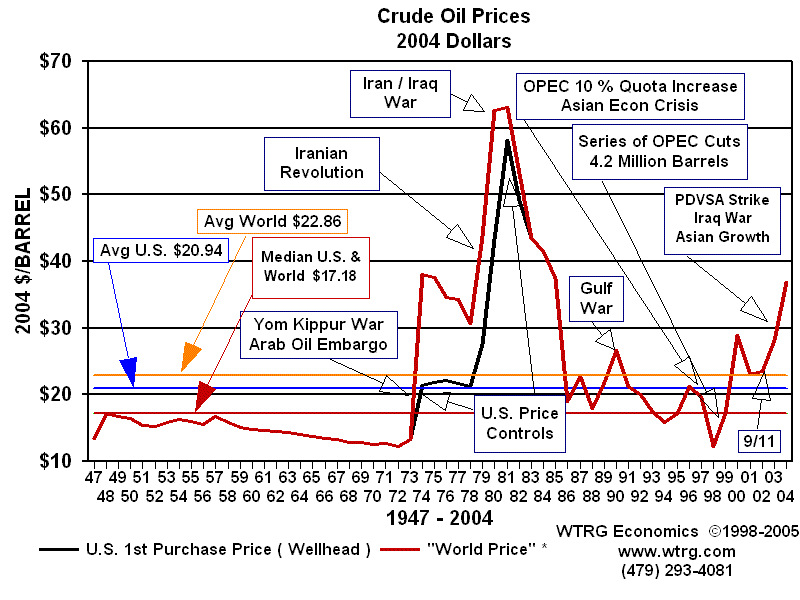
I was wondering whether the massive drop in oil prices that year was engineered in order to facilitate economic collapse in Russia, but having looked at this graph, it appears that such a scenario more likely could have happened in the late 1980s; if it occurred at all?
When were the impacts of the banking system's use of a new and unregulated form of 'high-power money' (in 1994) felt? I refer to money created through what has been referred to as "arcane procedures and instruments"; like 'zero-reserve sweeps'. These novel banking processes resulted in an enormous expansion of the money base that was largely concealed from public scrutiny. More on this topic here.
1998 – May 7th. Greenspan:
1998 – Global currency crisis associated with the the failure of Long term Capital Management. It was a currency trader. With the guidance of the US Fed all of the banks got together when it started to collapse and propped up the currency markets. Underscored is “the fact that
1998 – August 31st. Russia’s economic problems helped sent the Dow Jones Industrial Average to its second biggest single-day drop ever, 512 points.
1998 US IP owners imposed draconian new US copyright regime.[2]
Late 1990s. The percentage of people belonging to the middle class in the “old industrial countries” began to decline from the late 1990s to the present (August 2008). Making up for the falling incomes of First World workers for some years after 2000 was an increase in consumer credit. In 2007 a “popular default” broke out in the US. [3]
1998 – Present (2007. China’s huge labor surpluses absorbed through debt-financed investments in huge mega-projects that dwarf the already huge Three Gorges Dam. [4]
1998 – Book: The Buying of the Congress: How Special Interests Have Stolen Your Right to Life, Liberty, and the Pursuit of Happiness. Today ... there is no leadership or protest against our subjugation to the powerful economic interests that have captured our Congress and our politics. We are tired, and there is no alternative but to protest. (An appendix lists 32 leading members of Congress, along with each of their top ten career patrons (corporations and lobbying PACs). It's a depressing picture.) [5]
1998 – Doug Nolan’s Credit Bubble Bulletin begins.
1998 Hugo Chavez elected President in Venezuela (loss of oil to US)
1998 – Economic Giantism hastens
1998 – February 4th. US House of Reps Sub Committee. On the Asian Financial Crisis
1998 – Greenspan quote:
Late 1990s – The economy was growing, unemployment was creeping downward. Wages were increasing only modestly. Greenspan kept interest rates low, knowing that the workers’ fear of unemployment would continue to keep wages in check. The low interest rates fuelled the dotcom bubble. [7]
1998 – George Shultz vetted Bush Jr for the job as US president and put together the team behind his presidency. [8]
1998 September 21st. US Fed Reserve and 16 major Wall Street investment banks meet to organise a financial bailout of the hedge fund that they had all lent money to – Long Term Capital Management. There was real fear that the bond market would seize up as creditors rushed for the exits. The US Federal Reserve pushed billions of dollars of liquidity into the markets.
The US Fed denies involvement in the LTCM bailout.
"Perhaps [Paul Volker's] highest profile stance since his Fed days was taken during the Long-Term Capital Management fiasco of 1998. Volcker questioned the "bailout" of LTCM by the consortium of investment banks.
1998 – October 6th. IMF head, Michel Camdessus, warns of global systemic crisis.
1998 – October. Former chairman of the US Federal Reserve Board Paul Volcker said in a [then] recent speech to the International Finance Institute, published in the Financial Times:
[Volcker was referring to the multi-billion dollar bailout of the Long Term Capital Management hedge fund.]
1998 – October. As President Bill Clinton was warning of the worst financial crisis in 50 years, and calling for strong global leadership, the war against his administration being waged by powerful sections of the American bourgeoisie was intensifying with the House judiciary committee recommending an unrestricted investigation as to whether ground existed for his impeachment.[12]
1998 – November. Failure by the Organization of Petroleum Exporting Countries (OPEC) to cut production at its meeting in November 1998 prompted prices to collapse to a 12-year low of $10.35 a barrel in New York the following month.
1998 – Robert Rubin (then US Treasury Secretary) and Alan Greenspan persuaded Congress to change banking laws to permit the merger of Travelers Insurance, Citibank and Citigroup
1998 – October 21st. Discussing the 1998, 1987 and 1929 crashes. (Select Committee of the US Treasury. Minutes of evidence). Mr Davies: “It seems to me that we are somewhere in between the 1987 episode and the 1929 episode—hopefully a great deal closer to the 1987 episode…. So the Fed lost control of interest rates and to some extent sadly that has happened in recent weeks, although nothing like to the same degree…. The other element of the perverse policy was that fiscal policy generally was far too tight, so a combination of those events led to ten years of depression…. the world economy is generally weaker going into this crash than was true in 1987. Therefore, rebound would be slower and the background is weaker, so we will not get the rebound that we saw in 1988. Professor Minford: “after a big crash like 1987, which was on the same scale if not rather bigger than the share market crash we have seen in the last couple of months, that it was easy to turn round. We overdid it in retrospect…. There is no lack of liquidity today. In fact, some people maintain there is too much. Money supply in the United States is clearly growing quite robustly at this moment. All this points to the fact that we do have the ability to respond to this; and all the evidence is that we are responding to it…”
[1]Rigging the Market: The Secret Maneuverings of the Plunge Protection
Team
Mike Whitney, Information Clearing House, 09/14/06
http://www.undollars.com/archives/arch_undollar.whitney_9_17_06.htm
[2] The Bear's Lair, by Martin Hutchinson
http://www.prudentbear.com/articles/show/2070
The decline of Western incomes. July 23, 2007
[3] The crisis of the global economy
A report of the Institute of Globalisation and Social Movements, Moscow
By Vasily Koltashov
Translated by Renfrey Clarke, Links – International Journal of Socialist Renewal
http://links.org.au/node/517
[4] THE NEW IMPERIALISM: ON SPATIO-TEMPORAL FIXES AND ACCUMULATION BY DISPOSSESSION, David Harvey -- http://titanus.roma1.infn.it/sito_pol/Global_emp/Harvey.htm
[5] Lewis, Charles and the Center for Public Integrity. The Buying of the Congress: How Special Interests Have Stolen Your Right to Life, Liberty, and the Pursuit of Happiness. New York: Avon Books, 1998. 416 pages. ISBN 0-380-97596-3
http://www.namebase.org/cgi-bin/nb01/fB
[6] Greenspan 1998
http://www.federalreserve.gov/boarddocs/Speeches/1998/19980226.htm
[7] Michael Perelman. Chapter 2 of his draft book ‘The Invisible Handcuffs’.
http://michaelperelman.wordpress.com/2008/07/22/second-chapter-of-the-invisible-handcuffs-of-capitalism-how-market-tyranny-stifles-the-economy-by-stunting-workers/
[8] George Pratt Shultz: Profile of a Hit Man
by Scott Thompson and Nancy Spannaus
This article appears in the December 10, 2004 issue of Executive Intelligence Review.
http://www.larouchepub.com/other/2004/site_packages/econ_hitmen/3148shultz1.html
[9] Paul Volker - Part 2. Brian Trumbore
President/Editor, StocksandNews.com
http://www.buyandhold.com/bh/en/education/history/2000/paul_volker2.html
[10] Tuesday, 6 October, 1998, 19:41 GMT 20:41 UK
IMF chief warns of world crisis
http://news.bbc.co.uk/2/hi/187695.stm
[11] Conflicts dominate Washington meeting
World leaders at International Monetary Fund conference
acknowledge global economic crisis
By Nick Beams
8 October, 1998
http://www.wsws.org/news/1998/oct1998/econ-o08.shtml
[12] Conflicts dominate Washington meeting
World leaders at International Monetary Fund conference
acknowledge global economic crisis
By Nick Beams
8 October, 1998
http://www.wsws.org/news/1998/oct1998/econ-o08.shtml
I was wondering whether the massive drop in oil prices that year was engineered in order to facilitate economic collapse in Russia, but having looked at this graph, it appears that such a scenario more likely could have happened in the late 1980s; if it occurred at all?
When were the impacts of the banking system's use of a new and unregulated form of 'high-power money' (in 1994) felt? I refer to money created through what has been referred to as "arcane procedures and instruments"; like 'zero-reserve sweeps'. These novel banking processes resulted in an enormous expansion of the money base that was largely concealed from public scrutiny. More on this topic here.
1998 – May 7th. Greenspan:
"We need an understanding if we are to minimize the chances that 'we' will experience a systematic disruption beyond our degree of comprehension or our ability to respond effectively..."
1998 – Global currency crisis associated with the the failure of Long term Capital Management. It was a currency trader. With the guidance of the US Fed all of the banks got together when it started to collapse and propped up the currency markets. Underscored is “the fact that
“deregulation” has created an economic monster which requires more and more tinkering from the stewards of the system.”[1]
1998 – August 31st. Russia’s economic problems helped sent the Dow Jones Industrial Average to its second biggest single-day drop ever, 512 points.
1998 US IP owners imposed draconian new US copyright regime.[2]
Late 1990s. The percentage of people belonging to the middle class in the “old industrial countries” began to decline from the late 1990s to the present (August 2008). Making up for the falling incomes of First World workers for some years after 2000 was an increase in consumer credit. In 2007 a “popular default” broke out in the US. [3]
1998 – Present (2007. China’s huge labor surpluses absorbed through debt-financed investments in huge mega-projects that dwarf the already huge Three Gorges Dam. [4]
1998 – Book: The Buying of the Congress: How Special Interests Have Stolen Your Right to Life, Liberty, and the Pursuit of Happiness. Today ... there is no leadership or protest against our subjugation to the powerful economic interests that have captured our Congress and our politics. We are tired, and there is no alternative but to protest. (An appendix lists 32 leading members of Congress, along with each of their top ten career patrons (corporations and lobbying PACs). It's a depressing picture.) [5]
1998 – Doug Nolan’s Credit Bubble Bulletin begins.
1998 Hugo Chavez elected President in Venezuela (loss of oil to US)
1998 – Economic Giantism hastens
1998 – February 4th. US House of Reps Sub Committee. On the Asian Financial Crisis
1998 – Greenspan quote:
"Nor should we require individual banks to hold capital in amounts sufficient to fully protect against those rare systemic events which, in any event, may render standard probability evaluation moot. The management of systemic risk is properly the job of the central banks. Individual banks should not be required to hold capital against the possibility of overall financial breakdown. Indeed, central banks, by their existence, appropriately offer a form of catastrophe insurance to banks against such events."[6]
Late 1990s – The economy was growing, unemployment was creeping downward. Wages were increasing only modestly. Greenspan kept interest rates low, knowing that the workers’ fear of unemployment would continue to keep wages in check. The low interest rates fuelled the dotcom bubble. [7]
1998 – George Shultz vetted Bush Jr for the job as US president and put together the team behind his presidency. [8]
1998 September 21st. US Fed Reserve and 16 major Wall Street investment banks meet to organise a financial bailout of the hedge fund that they had all lent money to – Long Term Capital Management. There was real fear that the bond market would seize up as creditors rushed for the exits. The US Federal Reserve pushed billions of dollars of liquidity into the markets.
The US Fed denies involvement in the LTCM bailout.
"Perhaps [Paul Volker's] highest profile stance since his Fed days was taken during the Long-Term Capital Management fiasco of 1998. Volcker questioned the "bailout" of LTCM by the consortium of investment banks.
"Why should the weight of the federal government be brought to bear to help out a private investor?" [9]
1998 – October 6th. IMF head, Michel Camdessus, warns of global systemic crisis.
"We are speaking not just of countries in crisis, but of a system in crisis, a system not yet sufficiently adapted to the opportunities and risks of globalisation."[10]
1998 – October. Former chairman of the US Federal Reserve Board Paul Volcker said in a [then] recent speech to the International Finance Institute, published in the Financial Times:
“The problems we see with such force today are systemic--they arise from within the ordinary workings of global financial capitalism. ... Consider the latest bit of evidence from the US itself; one unsupervised and unregulated financial institution--an institution boasting the most elaborate models of market behaviour and sophisticated advisors--carried the possibility, by testimony of the US Federal Reserve, of pulling down the financial tent." [11]
[Volcker was referring to the multi-billion dollar bailout of the Long Term Capital Management hedge fund.]
1998 – October. As President Bill Clinton was warning of the worst financial crisis in 50 years, and calling for strong global leadership, the war against his administration being waged by powerful sections of the American bourgeoisie was intensifying with the House judiciary committee recommending an unrestricted investigation as to whether ground existed for his impeachment.[12]
1998 – November. Failure by the Organization of Petroleum Exporting Countries (OPEC) to cut production at its meeting in November 1998 prompted prices to collapse to a 12-year low of $10.35 a barrel in New York the following month.
1998 – Robert Rubin (then US Treasury Secretary) and Alan Greenspan persuaded Congress to change banking laws to permit the merger of Travelers Insurance, Citibank and Citigroup
1998 – October 21st. Discussing the 1998, 1987 and 1929 crashes. (Select Committee of the US Treasury. Minutes of evidence). Mr Davies: “It seems to me that we are somewhere in between the 1987 episode and the 1929 episode—hopefully a great deal closer to the 1987 episode…. So the Fed lost control of interest rates and to some extent sadly that has happened in recent weeks, although nothing like to the same degree…. The other element of the perverse policy was that fiscal policy generally was far too tight, so a combination of those events led to ten years of depression…. the world economy is generally weaker going into this crash than was true in 1987. Therefore, rebound would be slower and the background is weaker, so we will not get the rebound that we saw in 1988. Professor Minford: “after a big crash like 1987, which was on the same scale if not rather bigger than the share market crash we have seen in the last couple of months, that it was easy to turn round. We overdid it in retrospect…. There is no lack of liquidity today. In fact, some people maintain there is too much. Money supply in the United States is clearly growing quite robustly at this moment. All this points to the fact that we do have the ability to respond to this; and all the evidence is that we are responding to it…”
[1]Rigging the Market: The Secret Maneuverings of the Plunge Protection
Team
Mike Whitney, Information Clearing House, 09/14/06
http://www.undollars.com/archives/arch_undollar.whitney_9_17_06.htm
[2] The Bear's Lair, by Martin Hutchinson
http://www.prudentbear.com/articles/show/2070
The decline of Western incomes. July 23, 2007
[3] The crisis of the global economy
A report of the Institute of Globalisation and Social Movements, Moscow
By Vasily Koltashov
Translated by Renfrey Clarke, Links – International Journal of Socialist Renewal
http://links.org.au/node/517
[4] THE NEW IMPERIALISM: ON SPATIO-TEMPORAL FIXES AND ACCUMULATION BY DISPOSSESSION, David Harvey -- http://titanus.roma1.infn.it/sito_pol/Global_emp/Harvey.htm
[5] Lewis, Charles and the Center for Public Integrity. The Buying of the Congress: How Special Interests Have Stolen Your Right to Life, Liberty, and the Pursuit of Happiness. New York: Avon Books, 1998. 416 pages. ISBN 0-380-97596-3
http://www.namebase.org/cgi-bin/nb01/fB
[6] Greenspan 1998
http://www.federalreserve.gov/boarddocs/Speeches/1998/19980226.htm
[7] Michael Perelman. Chapter 2 of his draft book ‘The Invisible Handcuffs’.
http://michaelperelman.wordpress.com/2008/07/22/second-chapter-of-the-invisible-handcuffs-of-capitalism-how-market-tyranny-stifles-the-economy-by-stunting-workers/
[8] George Pratt Shultz: Profile of a Hit Man
by Scott Thompson and Nancy Spannaus
This article appears in the December 10, 2004 issue of Executive Intelligence Review.
http://www.larouchepub.com/other/2004/site_packages/econ_hitmen/3148shultz1.html
[9] Paul Volker - Part 2. Brian Trumbore
President/Editor, StocksandNews.com
http://www.buyandhold.com/bh/en/education/history/2000/paul_volker2.html
[10] Tuesday, 6 October, 1998, 19:41 GMT 20:41 UK
IMF chief warns of world crisis
http://news.bbc.co.uk/2/hi/187695.stm
[11] Conflicts dominate Washington meeting
World leaders at International Monetary Fund conference
acknowledge global economic crisis
By Nick Beams
8 October, 1998
http://www.wsws.org/news/1998/oct1998/econ-o08.shtml
[12] Conflicts dominate Washington meeting
World leaders at International Monetary Fund conference
acknowledge global economic crisis
By Nick Beams
8 October, 1998
http://www.wsws.org/news/1998/oct1998/econ-o08.shtml
Friday, September 18, 2009
A Negatively Sloped Hicksian Labour Supply Curve?
by the Sandwichman
The report of French President Nicholaus Sarkozy's Commission on the Measurement of Economic Performance and Social Progress, issued Monday, contains 184 instances of the word 'leisure'. The following, though, is from the Reflections and Overview of the Commission's principals, Joseph Stiglitz, Amartya Sen and Jean-Paul Fitoussi:
The canonical labor supply model treats leisure as a normal consumption good, which is questionable, to put it mildly. Below a culturally-determined income threshold, non-working time ceases to be available for use as leisure and instead becomes unemployment -- that is, a disutility rather than a utility. Likewise, for most occupations, there is an optimal length of working day and week in which the work itself enhances quality of life, aside from the income received from working. That optimum is likely to be rather dynamic and unstable. Indifference curves do not provide a suitable representation of these effects taken together.
At the end of their Reflections, the authors express the hope that their report will provide the impetus for a broader discussion of "societal values, for what we, as a society, care about, and whether we are really striving for what is important." This is a discussion, incidentally, that Sydney J. Chapman called for 100 years ago in the concluding paragraph of his "Hours of Labour":
The report of French President Nicholaus Sarkozy's Commission on the Measurement of Economic Performance and Social Progress, issued Monday, contains 184 instances of the word 'leisure'. The following, though, is from the Reflections and Overview of the Commission's principals, Joseph Stiglitz, Amartya Sen and Jean-Paul Fitoussi:
Surely, if one society chooses to limit its consumption of material goods, enjoying more leisure, including time devoted to culture, the arts, and community engagement, it should not be counted against it. Citizens in such a society might be far happier than in one which works longer hours, spending less time both with the family and in the community. Citizens in the hardworking society complain that, while they are working hard for the family, they have no time left for the family. Yet, our conventional measures would attribute better economic performance to the harder-working and unhappier society: both incomes and growth would be higher. Furthermore, the increase in average working time may be itself the consequence of the society’s malfunctioning. If inequality becomes pervasive, the number of persons who have to work harder to ensure their living may greatly increase (there is a negatively sloped Hicksian labour supply curve): they may claim that they have no choice but to work harder (though of course they could, were they willing to accept a much lower standard of material consumption than other citizens). It would be questionable whether this evolution is welfare-enhancing, even if GDP increases as a consequence.If leisure is a normal good... But, what if leisure isn't a normal good?
The canonical labor supply model treats leisure as a normal consumption good, which is questionable, to put it mildly. Below a culturally-determined income threshold, non-working time ceases to be available for use as leisure and instead becomes unemployment -- that is, a disutility rather than a utility. Likewise, for most occupations, there is an optimal length of working day and week in which the work itself enhances quality of life, aside from the income received from working. That optimum is likely to be rather dynamic and unstable. Indifference curves do not provide a suitable representation of these effects taken together.
At the end of their Reflections, the authors express the hope that their report will provide the impetus for a broader discussion of "societal values, for what we, as a society, care about, and whether we are really striving for what is important." This is a discussion, incidentally, that Sydney J. Chapman called for 100 years ago in the concluding paragraph of his "Hours of Labour":
Tangible things force themselves upon our attention as the more intangible do not, and some of us who have an economic bent of mind get into the way, in consequence, of thinking too much of the quantity of external wealth produced and too little of the balance between internal and external wealth. In ultimate terms, to those who care to put it that way, all wealth is life, as Ruskin insisted. There hardly appears to be any risk of a general underrating of external goods, but there is some risk of an underrating of the new needs of the life lived outside the hours devoted to production – which should themselves be, not a sacrifice to real living, but a part of it – and of an underrating of the dependence even of productive advance upon the widespread enjoyment and proper use of adequate leisure and an adequate income.Sidney Chapman's theory of the hours of labour, published in September 1909 in The Economic Journal, was acknowledged as authoritative by the leading economists of the day. It provided important insights into the prospects for market rationality with respect to work time arrangements and hinted at a profound immanent critique of economists' excessive concern with external wealth. Chapman's theory was consigned to obscurity by mathematical analyses that reverted heedlessly to outdated and naïve assumptions about the connection between hours and output. The centenary of the theory's publication offers an occasion to reconsider what has been lost by economists' neglect of Chapman's theory.
Notre Dame To Dissolve Heterodox Economics Department
The link to the story in the Chronicle of Higher Education is http://chronicle.com/article/Notre-Dame-to-Dissolve/48460. The bad guy in this is the dean, who wanted to have a "highly ranked" graduate program in economics (there was already a conventional econ department in the business school, but that was under another dean). So, he took away the grad program from the famous and productive, but heterodox and book-publishing (many of them very influential and important, check out Phil Mirowski's work) department. They set up what orthodox economist Robert Solow warned would be a "third rate MIT department," which he said we did not need another of. Now the axe is falling, and the heterodox department is to be completely eliminated. Supposedly the remnant tenured faculty will be scattered among other departments where they will be allowed to teach their upper level courses, but no principles or intermediate theory ones.
The department contains a number of important economists. Mirowski is the author of Machine Dreams and More Heat than Light. David Ruccio is the editor of Rethinking Marxism. Amitava Dutt is a development economist who is the author of numerous books, and there are others. This is a sad day, especially in light of the discredit that economic orthodoxy is standing in now.
The department contains a number of important economists. Mirowski is the author of Machine Dreams and More Heat than Light. David Ruccio is the editor of Rethinking Marxism. Amitava Dutt is a development economist who is the author of numerous books, and there are others. This is a sad day, especially in light of the discredit that economic orthodoxy is standing in now.
Minsky Punts, Part II
by the Sandwichman
"Employment is the bottom line of the current crisis. It is essential that governments focus on helping jobseekers in the months to come," stated Angel Gurria, Secretary General of the Organization for Economic Co-operation and Development yesterday at the launch of its Employment Outlook 2009. The OECD report anticipates that unemployment in the OECD countries could reach 57 million people and an unemployment rate of 10%. It points out that young people have been hardest hit by the jobs crisis.
Would a Minsky-inspired "job guarantee program" be an economically feasible response to that jobs crisis? Randal Wray is probably the best-known current advocate of such a program. In August, Wray posted a brief description of the idea along with some references for further reading. The Sandwichman's familiarity with the debate around the job guarantee idea comes largely from a discussion in Robert LaJeunesse's book, Work Time Regulation as Sustainable Full Employment Strategy, in which LaJeunesse sought to show why work time regulation would be superior to a jobs guarantee.
LaJeunesse's main objection to the job guarantee idea is that it expands work and consumption instead of questioning the compulsion for and ecological sustainability of perpetual, artificially-induced economic growth. Peter Victor's book, Managing without Growth, and the Sustainable Development Commission's report, Prosperity without Growth?, give persuasive evidence in support of such criticism.
While the Sandwichman agrees wholeheartedly with LaJeunesse's ecological critique, he also has microeconomic concerns about job guarantees. But first, before outlining those difficulties, more on the dimensions of the jobs crisis, and particularly the youth jobs crisis.
The official unemployment rate in August for 16-24 year olds was 18.2%. That's the seasonally adjusted "U3" number, using the narrow definition of unemployment. The BLS doesn't give "alternative measures of labor underutilization" by age categories. For the general population, the broadest measure if underemployment, U6, is 16.8% or about one and three-quarters times the official rate of 9.7%. Using the ratio of U6 to U3 to arrive at a conservative estimate of youth underemployment gives a total of 31.5% combined underemployment and unemployment.
Another way to gauge the real dimensions of the youth unemployment crisis is to look at the historical trend of the employment ratio. The current employment ratio of 46.6% is 8.5 percentage points lower than the 33 year-average. But even that average is skewed by the collapse of labor market participation that has occurred since 2001. Between January 2001 and December 2003, labor market participation of 16-24 year olds fell from 66% to 60.5%. But after that it remained virtually flat until January 2007 when it resumed its decline. In other words, although there was a modest recovery of three percentage points in the official unemployment rate the employment rate only regained about one percentage point from its 2001 recession low before heading downward again.
As the chart below shows, unemployment and under-participation leveled off at around 20% from 2003 to 2007 and then resumed their climb from near recession peak levels:

Scared yet? Returning now to Sandwichman's microeconomic objections to job guarantee schemes, there are three aspects that particularly trouble me. First is the historical precedent that explicitly "make work" jobs have always carried a stigma. This was true of the 19th century workhouse in Britain and of WPA jobs during the Great Depression.
Second, the necessity for some kind of administrative overhead -- managers, planners and staff -- must necessarily lead to the creation of a bureaucratic empire whose denizens will have a stake in the continuation and expansion of their institutional niche.
Finally, a job is not simply about the exchange of a certain amount of time and effort for a paycheck. Some kind of learning and social interaction goes on in the workplace. Not all of it is directly tied to the work. What kind of informal culture of "lifers" and "transients" is likely to emerge in buffer world of guaranteed jobs? What's to prevent the lifers (as well as the administrators) from devising schemes to divert the efforts of enrollees to their private interests?
"Employment is the bottom line of the current crisis. It is essential that governments focus on helping jobseekers in the months to come," stated Angel Gurria, Secretary General of the Organization for Economic Co-operation and Development yesterday at the launch of its Employment Outlook 2009. The OECD report anticipates that unemployment in the OECD countries could reach 57 million people and an unemployment rate of 10%. It points out that young people have been hardest hit by the jobs crisis.
Would a Minsky-inspired "job guarantee program" be an economically feasible response to that jobs crisis? Randal Wray is probably the best-known current advocate of such a program. In August, Wray posted a brief description of the idea along with some references for further reading. The Sandwichman's familiarity with the debate around the job guarantee idea comes largely from a discussion in Robert LaJeunesse's book, Work Time Regulation as Sustainable Full Employment Strategy, in which LaJeunesse sought to show why work time regulation would be superior to a jobs guarantee.
LaJeunesse's main objection to the job guarantee idea is that it expands work and consumption instead of questioning the compulsion for and ecological sustainability of perpetual, artificially-induced economic growth. Peter Victor's book, Managing without Growth, and the Sustainable Development Commission's report, Prosperity without Growth?, give persuasive evidence in support of such criticism.
While the Sandwichman agrees wholeheartedly with LaJeunesse's ecological critique, he also has microeconomic concerns about job guarantees. But first, before outlining those difficulties, more on the dimensions of the jobs crisis, and particularly the youth jobs crisis.
The official unemployment rate in August for 16-24 year olds was 18.2%. That's the seasonally adjusted "U3" number, using the narrow definition of unemployment. The BLS doesn't give "alternative measures of labor underutilization" by age categories. For the general population, the broadest measure if underemployment, U6, is 16.8% or about one and three-quarters times the official rate of 9.7%. Using the ratio of U6 to U3 to arrive at a conservative estimate of youth underemployment gives a total of 31.5% combined underemployment and unemployment.
Another way to gauge the real dimensions of the youth unemployment crisis is to look at the historical trend of the employment ratio. The current employment ratio of 46.6% is 8.5 percentage points lower than the 33 year-average. But even that average is skewed by the collapse of labor market participation that has occurred since 2001. Between January 2001 and December 2003, labor market participation of 16-24 year olds fell from 66% to 60.5%. But after that it remained virtually flat until January 2007 when it resumed its decline. In other words, although there was a modest recovery of three percentage points in the official unemployment rate the employment rate only regained about one percentage point from its 2001 recession low before heading downward again.
As the chart below shows, unemployment and under-participation leveled off at around 20% from 2003 to 2007 and then resumed their climb from near recession peak levels:

Scared yet? Returning now to Sandwichman's microeconomic objections to job guarantee schemes, there are three aspects that particularly trouble me. First is the historical precedent that explicitly "make work" jobs have always carried a stigma. This was true of the 19th century workhouse in Britain and of WPA jobs during the Great Depression.
Second, the necessity for some kind of administrative overhead -- managers, planners and staff -- must necessarily lead to the creation of a bureaucratic empire whose denizens will have a stake in the continuation and expansion of their institutional niche.
Finally, a job is not simply about the exchange of a certain amount of time and effort for a paycheck. Some kind of learning and social interaction goes on in the workplace. Not all of it is directly tied to the work. What kind of informal culture of "lifers" and "transients" is likely to emerge in buffer world of guaranteed jobs? What's to prevent the lifers (as well as the administrators) from devising schemes to divert the efforts of enrollees to their private interests?
Thursday, September 17, 2009
Diminishing returns for each dollar of new debt
Or 'why the economic stumuli won't go very far'.
Hmmm... could consumers be on strike whilst they pay off their debt? Could wealthy investors be purchasing gold and hiding it under their mattresses instead of creating 'real' wealth in the community? Could indebted oil-producing nations be hiking up the price of oil so that they can pay down their sovereign debt? And I wonder how much extra money is now being spent to repair the damage from (what used to be avoidable) climate change. So many questions and so few dollars!
[1] I do not subscribe to all of the view expressed by Antal Fekete. In particular, I am not a fan of 'the gold standard' because the application of it would not guarantee the absence of a debt bubble and the hoarding of 'gold' does make for a prosperous and healthy economy.
[2] Why The Stimulus Won't Work: The Marginal Productivity of Debt
http://yelnick.typepad.com/politick/2009/04/why-the-stimulus-wont-work-the-marginal-productivity-of-debt.html
"According to Antal Fekete [1] if you take this chart further back, we used to get $3 of GDP for every $1 of debt. Sometime in the late '60s, the line crossed below $1, meaning every new Dollar of debt returned less than that in GDP. Antal thinks we actual went negative in 2006, but regardless of whether his data is the same as this chart, we are approaching that point. This is truly a point of no return. This means every new $1 borrowed reduces GDP."[2]
Hmmm... could consumers be on strike whilst they pay off their debt? Could wealthy investors be purchasing gold and hiding it under their mattresses instead of creating 'real' wealth in the community? Could indebted oil-producing nations be hiking up the price of oil so that they can pay down their sovereign debt? And I wonder how much extra money is now being spent to repair the damage from (what used to be avoidable) climate change. So many questions and so few dollars!
[1] I do not subscribe to all of the view expressed by Antal Fekete. In particular, I am not a fan of 'the gold standard' because the application of it would not guarantee the absence of a debt bubble and the hoarding of 'gold' does make for a prosperous and healthy economy.
[2] Why The Stimulus Won't Work: The Marginal Productivity of Debt
http://yelnick.typepad.com/politick/2009/04/why-the-stimulus-wont-work-the-marginal-productivity-of-debt.html
How high energy prices create new economic 'norms'
Henry CK Liu wrote an interesting article in 2005 in which he outlines the rather dire implications for the US and global economy from rising energy prices. He claims, by the way, that the then quite dramatic rise in the price for gasoline was not the result of peak oil. Rather, he appears to say in this case, it came from high refinery costs. Please correct me if I've misinterpreted that point (and others). It is conceivable that the high cost of debt experienced by the petroleum cartel could also (easily) be added to the price of oil.
I've summarised the ten points Mr Liu has made on the subject below:
Fact 1: Energy prices are so basic to the global economy that, when they rise, the same material quantity in transactions simply involves greater cash flow. Higher oil prices do not take money out of the global economy but shift the profit to different sectors. Foreign oil producers must then shift their dollars back into US Treasury bonds or other dollar assets as part of the rules of the game of US dollar hegemony. A rise in monetary value of assets adds to the monetary wealth of the economy.
Fact 2: High energy costs translates into reduced consumption in other sectors unless higher income can be generated from the increased cash flow. Wage rises have a long time lag behind price increases. Workers may be able to increase their income by working longer hours in the meantime. The latter does not necessarily translate into productivity increases.
Fact 3: As cash flow increases for the same amount of material activities, the GDP rises while the economy stagnates. Purchases and sales amount to the same (maybe less) at a higher price and profit margin and with slightly more employees at lower pay per unit of revenue. The inflation from rapidly rising energy costs resulted in businesses hedging to protect themselves in the expanding structured finance world.
Fact 4: The impact of the sharp rise in energy prices results in asset values – in fact the entire commodity price chain - being in a upward spiral. It becomes possible to carry more debt without affected the debt-to-equity ratio. In effect this gives substance to a debt bubble and represents a defacto depreciation of money that is misidentified as growth.
Fact 5: High energy prices threaten the economic viability of some commercial sectors.
Fact 6: No interest-rate policy from any central bank can contain energy-cost-related inflation. Central banks can and do create debt bubbles.
Fact 7: War is a gluttonous consumer of oil. Waging war will translate therefore into rising dollar interest rates due to a higher US federal budget deficit. This is recessionary for the globalised economy but an economic stimulant in the US as long as collateral damage from the war occurs somewhere else.
Fact 8: In a debt bubble, oil in the ground can be more valuable than oil above ground because it can serve as a monetizable asset through asset-backed securities (ABS) in the wild, wild world of structured finance (derivatives). Also gasoline prices will not come down because there is no economic incentive to fix the shortage of crude oil refinery capacity. Refineries are among the most capital-intensive investments and the return on new investment will need continued high gasoline prices to pay for it.
Fact 9: The reason the US imports oil is that importing is cheaper and cleaner than extracting domestic oil – not because the US has a shortage of proven oil reserves.
Fact 10: Fifty-dollar oil [+] will buy the US debt bubble a little more time. Despite all the grandstand warnings about the need to reduce the US trade deficit, a case can be made that the United States cannot drastically reduce its trade deficit without paying the price of a sharp recession that could trigger a global depression.
From:
The real problems with $50 oil
By Henry C K Liu May 26, 2005
http://www.atimes.com/atimes/Global_Economy/GE26Dj02.html
I've summarised the ten points Mr Liu has made on the subject below:
Fact 1: Energy prices are so basic to the global economy that, when they rise, the same material quantity in transactions simply involves greater cash flow. Higher oil prices do not take money out of the global economy but shift the profit to different sectors. Foreign oil producers must then shift their dollars back into US Treasury bonds or other dollar assets as part of the rules of the game of US dollar hegemony. A rise in monetary value of assets adds to the monetary wealth of the economy.
Fact 2: High energy costs translates into reduced consumption in other sectors unless higher income can be generated from the increased cash flow. Wage rises have a long time lag behind price increases. Workers may be able to increase their income by working longer hours in the meantime. The latter does not necessarily translate into productivity increases.
Fact 3: As cash flow increases for the same amount of material activities, the GDP rises while the economy stagnates. Purchases and sales amount to the same (maybe less) at a higher price and profit margin and with slightly more employees at lower pay per unit of revenue. The inflation from rapidly rising energy costs resulted in businesses hedging to protect themselves in the expanding structured finance world.
Fact 4: The impact of the sharp rise in energy prices results in asset values – in fact the entire commodity price chain - being in a upward spiral. It becomes possible to carry more debt without affected the debt-to-equity ratio. In effect this gives substance to a debt bubble and represents a defacto depreciation of money that is misidentified as growth.
Fact 5: High energy prices threaten the economic viability of some commercial sectors.
Fact 6: No interest-rate policy from any central bank can contain energy-cost-related inflation. Central banks can and do create debt bubbles.
Fact 7: War is a gluttonous consumer of oil. Waging war will translate therefore into rising dollar interest rates due to a higher US federal budget deficit. This is recessionary for the globalised economy but an economic stimulant in the US as long as collateral damage from the war occurs somewhere else.
Fact 8: In a debt bubble, oil in the ground can be more valuable than oil above ground because it can serve as a monetizable asset through asset-backed securities (ABS) in the wild, wild world of structured finance (derivatives). Also gasoline prices will not come down because there is no economic incentive to fix the shortage of crude oil refinery capacity. Refineries are among the most capital-intensive investments and the return on new investment will need continued high gasoline prices to pay for it.
Fact 9: The reason the US imports oil is that importing is cheaper and cleaner than extracting domestic oil – not because the US has a shortage of proven oil reserves.
Fact 10: Fifty-dollar oil [+] will buy the US debt bubble a little more time. Despite all the grandstand warnings about the need to reduce the US trade deficit, a case can be made that the United States cannot drastically reduce its trade deficit without paying the price of a sharp recession that could trigger a global depression.
From:
The real problems with $50 oil
By Henry C K Liu May 26, 2005
http://www.atimes.com/atimes/Global_Economy/GE26Dj02.html
Wednesday, September 16, 2009
When Did The US Housing Bubble Begin?
In his most recent post on "Economics and its Discontents" on economic principals, David Warsh asserts that the US housing bubble occurred during 2003-06. In a thread following a post on this on Economist's View, I questioned this and said that it began in 1998, only to get a lot of criticism from others, with alternative beginning points being posed, including 2000 and 2001. I replied by noting that if one looks at the price-to-rent and price-to-income ratios for housing from both of the two indexes available (Case and Shiller and OFHEO, the latter having the bubble peaking in early 2007, while Case and Shiller say mid-2006) that showed these ratios taking off in 1998, although basically nobody noticed at the time because we were nearing the end of the dramatic dot.com bubble that crashed hard in early 2000. One can find a source for the OFHEO one here and for the Case and Shiller one here.
Now, part of what has people nonplussed I think is that both Kindleberger and Minsky used to argue that most bubbles start with some sort of identifiable "fundamentals displacement" that starts some price or prices on an upward path that then turns into a speculative bubble. But it is hard to identify such a displacement for housing in 1998. However, it seems that this is the case for some other of the really large bubbles of history, including the Mississippi one of 1719-20, the South Sea one of 1720, the 1920s stock market bubble, the 1980s one as well, and probably the dot.com bubble also. I wrote about this back in 1991 in my book, From Catastrophe to Chaos: A General Theory of Economic Discontinuities (repeated in second edition, 2000) on p. 61 as follows.
Now, part of what has people nonplussed I think is that both Kindleberger and Minsky used to argue that most bubbles start with some sort of identifiable "fundamentals displacement" that starts some price or prices on an upward path that then turns into a speculative bubble. But it is hard to identify such a displacement for housing in 1998. However, it seems that this is the case for some other of the really large bubbles of history, including the Mississippi one of 1719-20, the South Sea one of 1720, the 1920s stock market bubble, the 1980s one as well, and probably the dot.com bubble also. I wrote about this back in 1991 in my book, From Catastrophe to Chaos: A General Theory of Economic Discontinuities (repeated in second edition, 2000) on p. 61 as follows.
In all four of these cases the bubbles emerged after relatively long periods of general economic growth. Thus it may be that the trigger of these bubbles was a critical accumulation of general confidence and enthusiasm without any specific displacement of any fundamental being involved. It may well be that other episodes which have apparently begun with fundamental displacements may in fact have been "misspecified fundamentals" on the part of the participants. They mistakenly forecast that the initial displacement represented the future trend of the fundamental and the collapse of prices came when the illusion vanished. In this respect the lack of a clear initial displacement may be a way of identifying a pure speculative bubble. The pure bubble simply emerges from the swelling sea of boundless optimism, like Aphrodite from the froth.
Fiscal Stimulus Hits (Near To) Home
My oldest daughter, Meagan, who is about to turn 38 and is a single mother with a four and three quarters years old son, Charlie, works with disturbed teenagers in the Bay area in CA for an NGO that depends on public funds. Nearly a year ago her hours were cut back so that she lost her health insurance. She phoned me last night to tell me that thanks to an infusion of federal stimulus money, she will be put back on full time employment with her health insurance restored.
I also note that at James Madison University where I teach, the governor of the state mandated a 15% budget cut to us, which would have entailed layoffs. However, thanks to stimulus funds, it will be only about 8%, which although still entailing furloughs and plenty of cutting, will at least avoid any layoffs.
I also note that at James Madison University where I teach, the governor of the state mandated a 15% budget cut to us, which would have entailed layoffs. However, thanks to stimulus funds, it will be only about 8%, which although still entailing furloughs and plenty of cutting, will at least avoid any layoffs.
Tuesday, September 15, 2009
More on the Ways in Which Economics Fails to Conduct Itself Scientifically
Economics is only now beginning to come to terms with the external consistency demands posed by research in psychology, sociology and other related disciplines.
I’ve been thinking a bit more about science, pure and applied. My two criteria for “science-ness” thus far have been explanation (providing the causal mechanisms that generate outcomes) and giving priority to the minimization of Type I error. These have to do much more with pure science than applied, however. When a geologist assesses whether a site is stable enough to build on, she is concerned quite as much, if not more, with false negatives than false positives.
Where the two overlap, however, is in the role given to what can be called external consistency. Internal consistency is the property of logical coherence. Economists and others use math, for example, to test for it. An argument is externally consistent, however, if it does not contradict claims thought to be true made by other researchers, typically in adjacent fields. For instance, to be externally consistent a geological theory must adhere to the recognized results obtained in physics and chemistry.
The case for external consistency can be seen as a corollary to Type 1 error minimization: if your hypothesis butts up against arguments or evidence with enough credibility elsewhere, you are at heightened risk of being wrong. But what counts as enough credibility? There is no getting away from the fact that this is an elastic criterion. On one end we have the more-or-less indisputable results of real, fully tested sciences: if you violate any of them, you can’t be right. (I once had a student who proposed a project design for urban rainwater collection that would have violated the second law of thermodynamics. This was extreme.) On the other we have plausible results that have not yet been subjected to critical tests. How much credence we give them, and how we trade off this consideration against others, is a matter of judgment—one characteristic of the quality of a practitioner.
Economics is only now beginning to come to terms with the external consistency demands posed by research in psychology, sociology and other related disciplines. A good applied economist is someone who knows this work, can evaluate how compelling it is and how much impact it should have on the validity of economic models and methods.
I’ve been thinking a bit more about science, pure and applied. My two criteria for “science-ness” thus far have been explanation (providing the causal mechanisms that generate outcomes) and giving priority to the minimization of Type I error. These have to do much more with pure science than applied, however. When a geologist assesses whether a site is stable enough to build on, she is concerned quite as much, if not more, with false negatives than false positives.
Where the two overlap, however, is in the role given to what can be called external consistency. Internal consistency is the property of logical coherence. Economists and others use math, for example, to test for it. An argument is externally consistent, however, if it does not contradict claims thought to be true made by other researchers, typically in adjacent fields. For instance, to be externally consistent a geological theory must adhere to the recognized results obtained in physics and chemistry.
The case for external consistency can be seen as a corollary to Type 1 error minimization: if your hypothesis butts up against arguments or evidence with enough credibility elsewhere, you are at heightened risk of being wrong. But what counts as enough credibility? There is no getting away from the fact that this is an elastic criterion. On one end we have the more-or-less indisputable results of real, fully tested sciences: if you violate any of them, you can’t be right. (I once had a student who proposed a project design for urban rainwater collection that would have violated the second law of thermodynamics. This was extreme.) On the other we have plausible results that have not yet been subjected to critical tests. How much credence we give them, and how we trade off this consideration against others, is a matter of judgment—one characteristic of the quality of a practitioner.
Economics is only now beginning to come to terms with the external consistency demands posed by research in psychology, sociology and other related disciplines. A good applied economist is someone who knows this work, can evaluate how compelling it is and how much impact it should have on the validity of economic models and methods.
Casualties of the Crisis
Just in case we are too caught up in the blame game to keep our sense of priorities, here’s the abstract of a recent World Bank working paper (my emphasis):
The human consequences of the current global financial crisis for the developing world are presumed to be severe yet few studies have quantified such impact. The authors estimate the additional number of infant deaths in sub-Saharan Africa likely due to the crisis and discuss possible mitigation strategies. They pool birth-level data as reported in female adult retrospective birth histories from all Demographic and Health Surveys collected in sub-Saharan Africa nations. This results in a data set of 639,000 births to 264,000 women in 30 countries. The authors use regression models with flexible controls for temporal trends to assess an infant’s likelihood of death as a function of fluctuations in national income. They then apply this estimated likelihood to expected growth shortfalls as a result of the crisis. At current growth projections, their estimates suggest there will be 30,000 - 50,000 excess infant deaths in sub-Saharan Africa. Most of these additional deaths are likely to be poorer children (born to women in rural areas and lower education levels) and are overwhelmingly female. If the crisis continues to worsen the number of deaths may grow much larger, especially those to girls. Policies that protect the income of poor households and that maintain critical health services during times of economic contraction should be considered. Interventions targeted at female infants and young girls may be particularly beneficial.
"Because health-care resources are assumed to be fixed..."
by the Sandwichman
From an op-ed by Rupert Darwall in the Wall Street Journal today:
From an op-ed by Rupert Darwall in the Wall Street Journal today:
"The case for ObamaCare, as with the NHS, rests on what might be termed the "lump of health care" fallacy."
Monday, September 14, 2009
How Seriously Wrong John Cochrane Is
I have stated here already that I have problems with Paul Krugman's analysis of what went wrong with macro, most notably his nearly total ignoring of the analysis made by many heterodox economists. However, the inflamed reply by John Cochrane has been a joke. He presents himself as speaking for "the economics profession" rather than just a narrow group of Chicago-based or inspired economists. He is the expert, and Krugman supposedly makes trivial technical errors such as not distinguishing CAPM from Black-Scholes, etc. So, I decided to see how wise Cochrane is by going back to look at his widely praised (including even by Robert Shiller: "impressive treatise of very high quality" and "can also serve as a textbook in an advanced finance course") 2001 book published by Princeton University Press, _Asset Pricing_. On what has happened in the last few years, it is utterly useless.
In the index I went to find the following words/phrases: "fat tails" "kurtosis" "leptokurtosis." They are not there, even though pretty much all practitioners and a large literature already existed discussing how to explain the ubiquity in practically all asset markets of exactly those phenomena. He has a big fat zero to say about them, nothing.
I did find "bubbles," which he discusses briefly near the end of the book (pp. 399-402). He seems to recognize that they might exist, but his discussion is strictly in terms of "rational bubbles" and cites Peter Garber ("Tulipmania" JPE, 1989) on how they are not econometrically identifiable (and later says they do not explain empirical variations of price/dividend ratios; oh, and Garber). The model of rational bubbles he discusses supposedly must go on forever, which he then sneers at because "Infinity is a long time...The solar system will end at some point." Somehow he ignores the Blanchard-Watson 1983 paper on stochastically crashing bubbles, which indeed crash in finite time after rising at an accelerating rate to provide a risk premium for the ever-rising probability of the inevitable crash. Ironically, this last model lies at the base of the forecasting model used by econophysicist Didier Sornette and his associates, whose not-too-bad recent forecasting record on crashes is ultimately based on estimating the moment that such a process (complicated by oscillations) blows to infinity.
Oh, and Peter Garber is also wrong, see "Complex bubble persistence in closed-end country funds," by Ehsan Ahmed, Roger Koppl, me, and Mark V. White, Journal of Economic Behavior and Organization, Jan. 1997, 32(1), 19-37, although the basic insight that one can identify the fundamental by the net asset value of a closed-end fund and thus can identify increases in price of the fund above its NAV as a bubble had been made by many others prior to us. So, it is simply ridiculous of Cochrane to have ignored this point as well (he does recognize on p. 408 that some such funds trade regularly at discounts but never mentions that some have shown massive increases in price above NAV or that this clearly shows the existence of a bubble).
In the index I went to find the following words/phrases: "fat tails" "kurtosis" "leptokurtosis." They are not there, even though pretty much all practitioners and a large literature already existed discussing how to explain the ubiquity in practically all asset markets of exactly those phenomena. He has a big fat zero to say about them, nothing.
I did find "bubbles," which he discusses briefly near the end of the book (pp. 399-402). He seems to recognize that they might exist, but his discussion is strictly in terms of "rational bubbles" and cites Peter Garber ("Tulipmania" JPE, 1989) on how they are not econometrically identifiable (and later says they do not explain empirical variations of price/dividend ratios; oh, and Garber). The model of rational bubbles he discusses supposedly must go on forever, which he then sneers at because "Infinity is a long time...The solar system will end at some point." Somehow he ignores the Blanchard-Watson 1983 paper on stochastically crashing bubbles, which indeed crash in finite time after rising at an accelerating rate to provide a risk premium for the ever-rising probability of the inevitable crash. Ironically, this last model lies at the base of the forecasting model used by econophysicist Didier Sornette and his associates, whose not-too-bad recent forecasting record on crashes is ultimately based on estimating the moment that such a process (complicated by oscillations) blows to infinity.
Oh, and Peter Garber is also wrong, see "Complex bubble persistence in closed-end country funds," by Ehsan Ahmed, Roger Koppl, me, and Mark V. White, Journal of Economic Behavior and Organization, Jan. 1997, 32(1), 19-37, although the basic insight that one can identify the fundamental by the net asset value of a closed-end fund and thus can identify increases in price of the fund above its NAV as a bubble had been made by many others prior to us. So, it is simply ridiculous of Cochrane to have ignored this point as well (he does recognize on p. 408 that some such funds trade regularly at discounts but never mentions that some have shown massive increases in price above NAV or that this clearly shows the existence of a bubble).
Earthquakes, Financial and Geological
As Paul Krugman’s diagnosis of the state of economics bounces around the blogosphere, we are being treated once again to the old debate over whether economics can ever be as scientific as the “real” sciences, the hard ones that have big budgets for lab gear.
If you want to talk about hard sciences, talk about geology. They even have hardness tests, which I remember from my freshman course many long years ago. (I did pretty well in it, but would have done better if I could have ID’ed coal on a midterm exam.) Yet when it comes to a crucial task like predicting earthquakes, geologists are not much better than the pseudo-scientists who populate economics departments. They do even worse, actually, when you consider that their margins of error are hundreds of miles, hundreds of years, and an order of magnitude or two. This makes Alan Greenspan look like Nostradamus.
But of course, that’s not what does or does not qualify geology as a science. Rather, scientists are researchers who subject themselves to rigorous falsification testing that, in the long run, weeds out error. What’s important about the study of earthquakes, for instance, is not its predictive power but that it’s based on an understanding derived from plate tectonics. Yet this was not always the case. That freshman course I mentioned was taught by some of the last holdouts against plate theory; we learned about igneous intrusions and isostatic rebound, but not subduction faults.
You can’t take a course like that any more, because the reward system for geologists gives lots of points for devising critical tests and takes away even more for failure to pass them. Suppose there were a parallel universe in which geologists acted like economists. You might have a popular school of thought that holds that earthquakes are caused by the differential pressure exerted by topography; that’s why there are more quakes in California than Kansas. You could show that the coefficient on topographical variation is significant at a very low p-value in a pooled cross-section. You could calibrate a model showing how much variation is associated with how many earthquakes. Hell, you could generate hundreds of models with different functional forms and control variables and estimators and build whole careers around nuanced discussions of which one “performs” better.
But none of this has anything to do with science. In the universe we actually live in, geologists looked for critical tests: evidence that decisively discriminated between plate tectonics and competing theories.
If you want to tell me that people formulate lifetime spending plans based on the present value of their expected future stream of real after-tax income, and that because of this any dollar of additional government spending is a dollar less of private spending, fine. But don’t calibrate it or show me results “consistent” with it. Think of a critical test, a real-world situation in which we would get a particular result only if this story is correct, and then live or die by the result. Yes, I know this can be difficult in economics, just as it is in geology, but it’s even harder if you don’t try.
If you want to talk about hard sciences, talk about geology. They even have hardness tests, which I remember from my freshman course many long years ago. (I did pretty well in it, but would have done better if I could have ID’ed coal on a midterm exam.) Yet when it comes to a crucial task like predicting earthquakes, geologists are not much better than the pseudo-scientists who populate economics departments. They do even worse, actually, when you consider that their margins of error are hundreds of miles, hundreds of years, and an order of magnitude or two. This makes Alan Greenspan look like Nostradamus.
But of course, that’s not what does or does not qualify geology as a science. Rather, scientists are researchers who subject themselves to rigorous falsification testing that, in the long run, weeds out error. What’s important about the study of earthquakes, for instance, is not its predictive power but that it’s based on an understanding derived from plate tectonics. Yet this was not always the case. That freshman course I mentioned was taught by some of the last holdouts against plate theory; we learned about igneous intrusions and isostatic rebound, but not subduction faults.
You can’t take a course like that any more, because the reward system for geologists gives lots of points for devising critical tests and takes away even more for failure to pass them. Suppose there were a parallel universe in which geologists acted like economists. You might have a popular school of thought that holds that earthquakes are caused by the differential pressure exerted by topography; that’s why there are more quakes in California than Kansas. You could show that the coefficient on topographical variation is significant at a very low p-value in a pooled cross-section. You could calibrate a model showing how much variation is associated with how many earthquakes. Hell, you could generate hundreds of models with different functional forms and control variables and estimators and build whole careers around nuanced discussions of which one “performs” better.
But none of this has anything to do with science. In the universe we actually live in, geologists looked for critical tests: evidence that decisively discriminated between plate tectonics and competing theories.
If you want to tell me that people formulate lifetime spending plans based on the present value of their expected future stream of real after-tax income, and that because of this any dollar of additional government spending is a dollar less of private spending, fine. But don’t calibrate it or show me results “consistent” with it. Think of a critical test, a real-world situation in which we would get a particular result only if this story is correct, and then live or die by the result. Yes, I know this can be difficult in economics, just as it is in geology, but it’s even harder if you don’t try.
The 'medium' is what you actually do.
In 1970 Charles A Reich wrote his book 'The Greening of America' in praise of the cultural protest movement of the 1960s.. It was one of the most personally influential books I have read.
Over the years since Reich's publication the mainstream media have placed much emphasis on the relative affluence of the young people of '60s generation. Leading journalists and TV hosts often supposed that an unprecedented rise in material wealth was somehow causative of the rebellious spirit that was the hallmark of the youth at that time.
It is clear, however, that great waves of alienation with modern western society had already swelled in the hearts of many individuals that were born in a different time altogether. As much as many former hipsters would hate the thought, the real depths of dissent that shaped the events of the 1960s may have actually come from their parents' and earlier generations. A small, particularly articulate and thoughtful number of people such as the likes of Martin Luther King, Charles Reich (as above), John Kenneth Galbraith, C Wright Mills, John Fitzgerald Kennedy, Robert Kennedy, Lewis Mumford, Laurence J Peter, Barry Commoner, Karl Polanyi and others took the limelight and shaped the thoughts of many a draft-dodger and pot-smoking greenie.
What was new and potentially revolutionary was the new medium of television and the ubiquity of cheap books; these people mostly understood how to use these media to best advantage. They knew well the ways and means by which public consciousness was actively manipulated and sought to explain this predicament to their large audiences.
In 1970, for instance, Charles Reich drew upon the thinking of Marshall McLuhan to explain how the medium of our lives was the real message:
More likely, the father would respond to his son by saying:
Reich moves his focus onto the trapped realm of the modern 'liberal-intellectual'. No matter how great their sophistication, he says, they still keep to such goals as excellence, approval of colleagues, recognition and achievement. They may have fewer myths or illusions, but their despairing view of life's possibilities bar their way to a new consciousness and their dependence on goals involving outside approval deprives them of courage to be themselves.
To profess freedom without a change in personal consciousness it seems to me is like wanting the thunder and lightening without the rain, to want the sun without the heat and the light.
“No creature can learn that which his heart has no shape to hold.”**
** 'All the Pretty Horses', McCarthy 1992
Over the years since Reich's publication the mainstream media have placed much emphasis on the relative affluence of the young people of '60s generation. Leading journalists and TV hosts often supposed that an unprecedented rise in material wealth was somehow causative of the rebellious spirit that was the hallmark of the youth at that time.
It is clear, however, that great waves of alienation with modern western society had already swelled in the hearts of many individuals that were born in a different time altogether. As much as many former hipsters would hate the thought, the real depths of dissent that shaped the events of the 1960s may have actually come from their parents' and earlier generations. A small, particularly articulate and thoughtful number of people such as the likes of Martin Luther King, Charles Reich (as above), John Kenneth Galbraith, C Wright Mills, John Fitzgerald Kennedy, Robert Kennedy, Lewis Mumford, Laurence J Peter, Barry Commoner, Karl Polanyi and others took the limelight and shaped the thoughts of many a draft-dodger and pot-smoking greenie.
What was new and potentially revolutionary was the new medium of television and the ubiquity of cheap books; these people mostly understood how to use these media to best advantage. They knew well the ways and means by which public consciousness was actively manipulated and sought to explain this predicament to their large audiences.
In 1970, for instance, Charles Reich drew upon the thinking of Marshall McLuhan to explain how the medium of our lives was the real message:
"....let us borrow some thinking frm Marshall McLuhan. A young boy asks his father, "What do you do, Daddy?". Here is how the father might answer:
"I struggle with crowds, traffic jams and parking problems for about an hour. I talk a great deal on the telephone to people I hardly know. I dictate to a secretary and then proof-read what she types. I have all sorts of meetings wtih people I don't know very well or like very much. I eat lunch in a big hurry and can't taste or remember what I've eaten. I hurry, hurry, hurry. I spend my time in very functional offices with very functional furniture, and I never look at the weather or sky or people passing by. I talk but I don't sing or dance or touch people. I spend the last hour, all alone, struggleing with crowds, traffic and parking."
More likely, the father would respond to his son by saying:
"I am a lawyer. I help people and businesses to solve their problems. I help everybody to know the rules that we all have to live by, and to get along according to these rules."
Reich moves his focus onto the trapped realm of the modern 'liberal-intellectual'. No matter how great their sophistication, he says, they still keep to such goals as excellence, approval of colleagues, recognition and achievement. They may have fewer myths or illusions, but their despairing view of life's possibilities bar their way to a new consciousness and their dependence on goals involving outside approval deprives them of courage to be themselves.
To profess freedom without a change in personal consciousness it seems to me is like wanting the thunder and lightening without the rain, to want the sun without the heat and the light.
“No creature can learn that which his heart has no shape to hold.”**
** 'All the Pretty Horses', McCarthy 1992
Sunday, September 13, 2009
Why Japanese Health Care is Bad
Harden, Blaine. 2009. "Health Care in Japan: Low-Cost, for Now: Aging Population Could Strain System." Washington Post. (7 September).
So, public intervention of the medical system is obviously bad. The problem is that the Japanese health system makes the mistake of failing to let enough people die. The article does admit that a healthy lifestyle is also a factor, but let's hope that the US does not follow Japan.
Half a world away from the U.S. health-care debate, Japan has a system that costs half as much and often achieves better medical outcomes than its American counterpart. It does so by banning insurance company profits, limiting doctor fees and accepting shortcomings in care that many well-insured Americans would find intolerable.
But many health-care economists say Japan's low-cost system is probably not sustainable without significant change. Japan already has the world's oldest population; by 2050, 40 percent will be 65 or older. The disease mix is becoming more expensive to treat.
So, public intervention of the medical system is obviously bad. The problem is that the Japanese health system makes the mistake of failing to let enough people die. The article does admit that a healthy lifestyle is also a factor, but let's hope that the US does not follow Japan.
Why Capitalism Fails... and Minsky Punts!
by the Sandwichman
The Boston Globe today carries an op-ed by Stephen Mihm, a history professor at the University of Georgia, highlighting the aptness of Hyman Minsky's financial instability hypothesis:
The political objections to the latter policy would seem at first glance to be insurmountable. But hold on a minute. A few years ago, the "house-price bubble" only existed in the fevered rantings of a smattering of chronic doomsayers. Today, who has heard of the "youth jobs crisis"? No one. Crisis? What crisis? Here's the chart again. Read it and weep.
Employment-Population Ratio - 16-24 yrs. Seasonally Adjusted
 Digging deeper into the data, it gets worse. Long story short: youth employment has been COLLAPSING since the bursting of the dot.com bubble in 2000. There was no recovery for youth employment during the last "boom" -- only a leveling off. In the context of the youth employment crisis -- which will not be solved by a traditional bastard Keynesian fiscal-spending stimulus -- a far-reaching government jobs program might become politically feasible. But would it be economically feasible? Sandwichman doubts it. (to be continued...)
The Boston Globe today carries an op-ed by Stephen Mihm, a history professor at the University of Georgia, highlighting the aptness of Hyman Minsky's financial instability hypothesis:
Modern finance, he argued, was far from the stabilizing force that mainstream economics portrayed: rather, it was a system that created the illusion of stability while simultaneously creating the conditions for an inevitable and dramatic collapse."But does Minsky’s work offer us any practical help?" Mihm asks. Part of the solution, he continues, is to have the Federal Reserve act as a lender of last resort to distressed firms. Nothing new there. But the other part is more radical: to have the government act as employer of last resort, guaranteeing a job to anyone who wanted one.
In other words, the one person who foresaw the crisis also believed that our whole financial system contains the seeds of its own destruction. "Instability," he wrote, "is an inherent and inescapable flaw of capitalism."
The political objections to the latter policy would seem at first glance to be insurmountable. But hold on a minute. A few years ago, the "house-price bubble" only existed in the fevered rantings of a smattering of chronic doomsayers. Today, who has heard of the "youth jobs crisis"? No one. Crisis? What crisis? Here's the chart again. Read it and weep.
 Digging deeper into the data, it gets worse. Long story short: youth employment has been COLLAPSING since the bursting of the dot.com bubble in 2000. There was no recovery for youth employment during the last "boom" -- only a leveling off. In the context of the youth employment crisis -- which will not be solved by a traditional bastard Keynesian fiscal-spending stimulus -- a far-reaching government jobs program might become politically feasible. But would it be economically feasible? Sandwichman doubts it. (to be continued...)
The Futility of Financial Regulation: Lessons from Science and Professional Football
The Wall Street Journal does not make the connection explicit, the editors must realize that the sophisticated investors, who own luxury boxes (or even professional football teams), will get the message: financial regulation is futile. The offense has a scientific advantage over the defense. No matter what strategy the defense uses, the offense can find a way to overpower it. The Journal even gives scientific analysis to make this point. Of course, the possibility remains, of moving from a competitive capitalistic game to a more cooperative system will eliminate the need for offenses and defenses. Notice the similarity between the analysis of football and neoclassical descriptions of the economy.
Futterman, Matthew. 2009. "Behind the NFL's Touchdown Binge As Scoring Soars, One Professor Sees Parallels in Nature; the 'River Basin' Theory." Wall Street Journal (10 September).
Futterman, Matthew. 2009. "Behind the NFL's Touchdown Binge As Scoring Soars, One Professor Sees Parallels in Nature; the 'River Basin' Theory." Wall Street Journal (10 September).
The NFL has become so fast and efficient that last season, teams each scored 22.03 points per game, the highest since 1967, while all the league's 32 teams combined for 11,279 points—the most in NFL history.
The game has become less cluttered. Offenses averaged just 3.09 turnovers (interceptions and fumbles) per game, the lowest of all time by more than 10%, and offensive lines allowed just 4.04 sacks per game—also the lowest ever. Even place kickers set a new mark: They made a record-high 84.5% of their field-goal attempts.
Adrian Bejan a professor of mechanical engineering at Duke University, likens the NFL's evolution to a river's effect on its basin. (Stay with us, here.) Over time, a river relentlessly wears away its banks and, as a result, water flows faster and faster toward its mouth. When obstacles fall in its way, say, a tree, or a boulder -- or in the case of an NFL offense, beefy linebackers like the Baltimore Ravens' Ray Lewis or the Chicago Bears' Brian Urlacher -- it will figure out how to wear those away, too.
"The game is a flow system, a river basin of bodies that are milling around trying to find the most effective and easiest way to move," says Prof. Bejan. "Over time you will end up with the right way to play the game, with the patterns that are the most efficient."
In 1996, Prof. Bejan, who began following the NFL after coming to the U.S. from Romania to attend college, came up with a theory about natural phenomena known as the Constructal Law. The theory, he says, can be used to explain the evolution of efficiency in everything from river basins to mechanical design. By extension, he says, it could also be applied to the explosion of offense in the NFL.
Tom Lemming, the recruiting expert and analyst for CBS College Sports, says no one on the college level has figured out how to neutralize the speed of the spread offense, either. "The offense always sets the agenda, and the defense plays catch-up," Mr. Lemming says.
Considered more broadly, Constructal Law may be the closest thing to a grand unified theory for the evolution of sports. In a sports context, the river is the relentless search for the easiest way to score or win more often. In soccer, there is the indefensible through-ball, passed between two defenders to a striker sprinting into open space. In basketball, the two-handed set shot eventually gave way to finding the tallest, fastest players who could jump the highest and dunk.
Saturday, September 12, 2009
Cochrane's Complaint
by the Sandwichman
I did learn this from Cochrane's essay: "the central empirical prediction of the efficient markets hypothesis is precisely that nobody can tell where markets are going.... . This is probably the best-tested proposition in all the social sciences." Hello? That is indeed a fascinating thing. Markets are efficient because nobody can tell where they are going. That is to say, if nobody can tell where they are going; then markets are efficient. Or, to put it more bluntly, if there is a Goldman, Sachs; then there is no such thing as an efficient market. Notwithstanding the non-trivial detail that the term "efficient" in the proposition is either a non sequitur or a tautolgy. What are efficient markets efficient at? Being inscrutable!
The catch is there will always be a Goldman, Sachs. The inherent tendency of all markets is toward monopolization and manipulation. It is precisely because people will not settle for the "nobody can tell" fairy tale that markets get rigged. To pretend that actually existing markets are somehow almost the same thing as efficient markets is no different than pretending that actually existing socialism was virtually a workers' paradise or that the moon is made of green cheese and the central bank is a green cheese factory. It's all dress up and make believe.
Like Paul Krugman, John Cochran has no interesting ideas whatsoever about what caused our current financial and economic problems, what policies might have prevented it, or what might help us in the future, and he has no contact with people who do.
Paul Krugman has no interesting ideas whatsoever about what caused our current financial and economic problems, what policies might have prevented it, or what might help us in the future, and he has no contact with people who do. "Irrationality" and advice to spend like a drunken sailor are pretty superficial compared to all the fascinating things economists are writing about it these days.How sad, indeed. All the fascinating things economists are writing about "it" these days! What does the word "it" refer to? What caused our current financial and economic problems? What policies might have prevented it? What might help us in the future? Perhaps a little math would help:
How sad.
Math in economics serves to keep the logic straight, to make sure that the "then" really does follow the "if," which it so frequently does not if you just write prose.That depends on what the meaning of the word "if" is. Or the word "it". And "what". Professor Cochrane's mistake was not waiting a week before uncorking his rant and giving himself the opportunity of filing it in the unsent-rants file where it belongs.
I did learn this from Cochrane's essay: "the central empirical prediction of the efficient markets hypothesis is precisely that nobody can tell where markets are going.... . This is probably the best-tested proposition in all the social sciences." Hello? That is indeed a fascinating thing. Markets are efficient because nobody can tell where they are going. That is to say, if nobody can tell where they are going; then markets are efficient. Or, to put it more bluntly, if there is a Goldman, Sachs; then there is no such thing as an efficient market. Notwithstanding the non-trivial detail that the term "efficient" in the proposition is either a non sequitur or a tautolgy. What are efficient markets efficient at? Being inscrutable!
The catch is there will always be a Goldman, Sachs. The inherent tendency of all markets is toward monopolization and manipulation. It is precisely because people will not settle for the "nobody can tell" fairy tale that markets get rigged. To pretend that actually existing markets are somehow almost the same thing as efficient markets is no different than pretending that actually existing socialism was virtually a workers' paradise or that the moon is made of green cheese and the central bank is a green cheese factory. It's all dress up and make believe.
Like Paul Krugman, John Cochran has no interesting ideas whatsoever about what caused our current financial and economic problems, what policies might have prevented it, or what might help us in the future, and he has no contact with people who do.
Friday, September 11, 2009
Job-Market Slack as "Leading Indicator"
by the Sandwichman
A couple of days ago, the Sandwichman characterized the employment-as-a-lagging-indicator meme as a prescription for doing nothing. Yesterday, over on Macroblog, David Altig contemplated, "Economists got it wrong, but why?" concluding, "I've yet to see the evidence that progress requires moving beyond the intellectual boundaries in which most economists already live." That comment sent the S-man down memory lane to a WSJ debate on job market slack Max Sawicky and Sandwichman had with David Altig back in the boom times of August, 2005.
Max and I were of the opinion that the job market was then slack in spite of a nominal 5% unemployment rate. David Altig leaned toward the interpretation that changes in labor force participation were being driven by demographic trends and the informed choice of participants and non-participants. In hindsight, I wish we had followed up on the demographic clue. Decomposing the employment-population ratio by age groups produces the following arresting picture:
Employment-Population Ratio - 16-24 yrs. Seasonally Adjusted
While the drop-off since September 2008 has been steep, the decline began in December 2006, three months before unemployment bottomed out for 16-24 year olds. Perhaps more auspicious, the "peak" employment-population ratio for 16-24 year olds during the last recovery barely climbed above it's trough following the 2001 recession. As they say, the youth of today is the future -- or the canary in the coal mine. The above chart is "evidence that progress requires moving beyond the intellectual boundaries in which most economists already live" whether David Altig sees it that way or not.
A couple of days ago, the Sandwichman characterized the employment-as-a-lagging-indicator meme as a prescription for doing nothing. Yesterday, over on Macroblog, David Altig contemplated, "Economists got it wrong, but why?" concluding, "I've yet to see the evidence that progress requires moving beyond the intellectual boundaries in which most economists already live." That comment sent the S-man down memory lane to a WSJ debate on job market slack Max Sawicky and Sandwichman had with David Altig back in the boom times of August, 2005.
Max and I were of the opinion that the job market was then slack in spite of a nominal 5% unemployment rate. David Altig leaned toward the interpretation that changes in labor force participation were being driven by demographic trends and the informed choice of participants and non-participants. In hindsight, I wish we had followed up on the demographic clue. Decomposing the employment-population ratio by age groups produces the following arresting picture:
While the drop-off since September 2008 has been steep, the decline began in December 2006, three months before unemployment bottomed out for 16-24 year olds. Perhaps more auspicious, the "peak" employment-population ratio for 16-24 year olds during the last recovery barely climbed above it's trough following the 2001 recession. As they say, the youth of today is the future -- or the canary in the coal mine. The above chart is "evidence that progress requires moving beyond the intellectual boundaries in which most economists already live" whether David Altig sees it that way or not.
Subscribe to:
Posts (Atom)